














Just getting started making yogurt at home? While making yogurt is a relatively simple process, we understand that a lot of questions can pop up when starting something new. We've compiled the most frequently asked questions our customers have about yogurt starters and yogurt making to help you on your next yogurt-making project.
If you've already started making yogurt on your own, check out our Yogurt Troubleshooting FAQ for more help with those tricky culturing situations.
Have you always wanted to make your yogurt at home? It's easier than you think! Download your Yogurt Guide today, and learn everything about making yogurt, including recipes for delicious and healthy yogurt dishes.
Jump to a Section:
YOGURT STARTER FAQS
Q. What is a yogurt starter?
A. Yogurt starter is a carefully balanced blend of bacteria which consume lactose. This converts the lactose in the milk to lactic acid, giving the yogurt that classic, deliciously tangy taste. Lactic acid production lowers the pH of the milk, which allows it to be stored longer and changes the protein structure, giving yogurt its texture. Each starter has a unique blend of bacteria, with different flavors and thicknesses.
Q. What types of yogurt starter cultures do you carry?
A. We carry direct-set and heirloom yogurt starter cultures. The heirloom starters are available in two types, mesophilic and thermophilic.
Q. What is the difference between the direct-set and the heirloom starter cultures?
A. Direct-set yogurt starter cultures are single-use cultures: one packet makes one batch of yogurt. Heirloom yogurt starter cultures are reusable indefinitely, with care. Heirloom yogurts must be re-cultured at least every 7 days.
Q. What is the difference between mesophilic and thermophilic yogurt starter cultures?
A. Mesophilic yogurt starters culture at room temperature, 70º-77ºF. Thermophilic yogurt starters culture at approximately 110ºF.
Q. What yogurt starter cultures do you carry?
A. We carry the following starters:
- Direct-Set Yogurt Starters: Mild Flavor, Traditional Flavor, Kosher Mild Flavor, Kosher Traditional Flavor, and Vegan Yogurt.
- Heirloom Mesophilic: Viili, Piima, Filmjolk, Matsoni (Available in the Heirloom Varieties Pack)
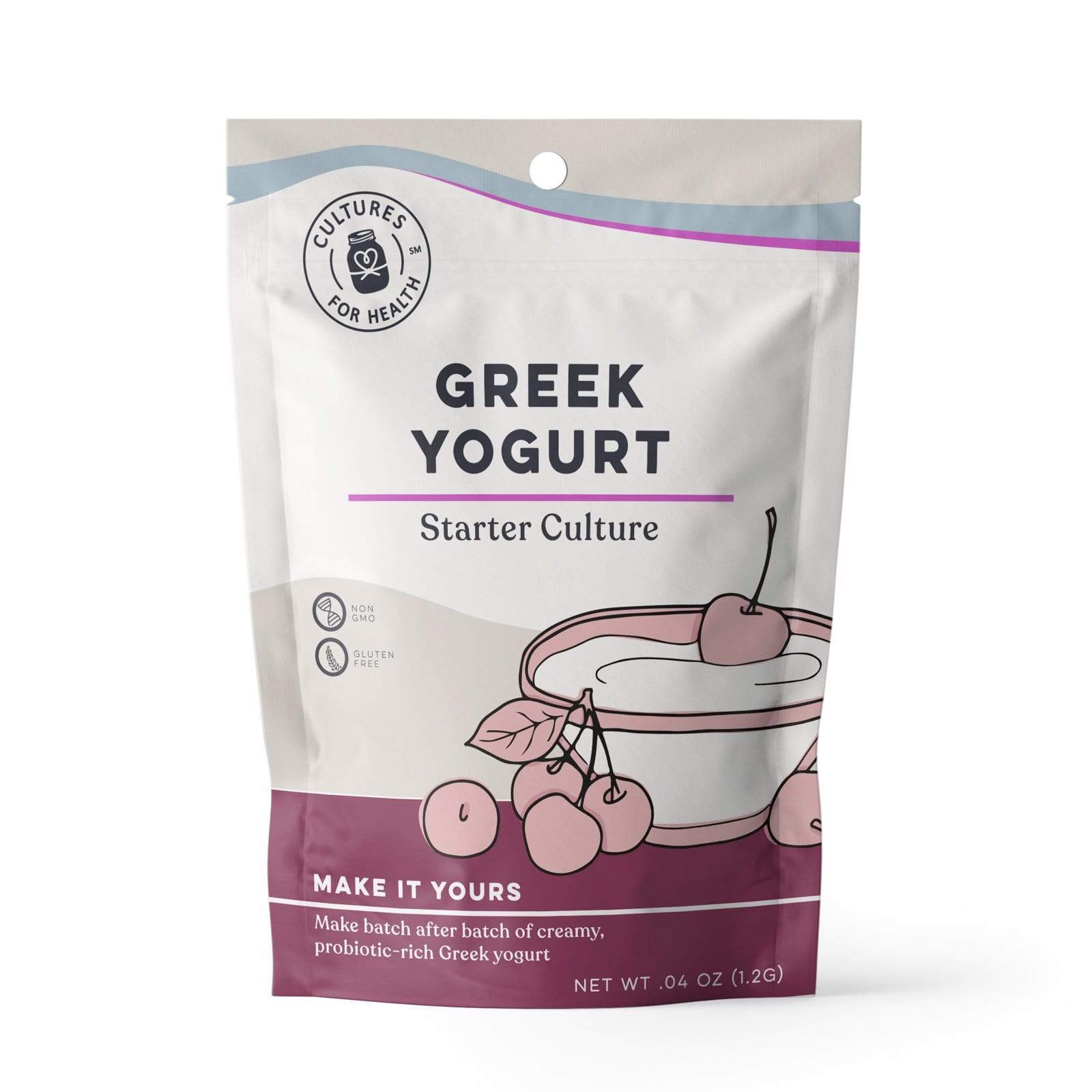
- Heirloom Thermophilic: Bulgarian, Greek

You can learn more about each of these in our article on Choosing a Yogurt Starter.
Q. What supplies do I need to make yogurt at home with a yogurt starter?
Along with a yogurt starter and milk, there are few supplies you will need to make homemade yogurt. This will vary based on the yogurt starter you choose to use.
- For Direct-Set Yogurt (Vegan Yogurt, Traditional, Mild Flavor Starters): A yogurt maker, or warm spot, a thermometer, and a pan to heat up the milk. This is our easiest-to-use starter. Have rich, delicious yogurt quickly!
- Heirloom Thermophilic Yogurt (Greek, Bulgarian Starters): These are very much like our direct set yogurts, and store-bought yogurt in terms of taste and texture. You'll need a yogurt maker or a spot that can hold a temperature of 110°F for up to 12 hours, a pan, thermometer and containers to culture in if your yogurt maker doesn't come with jars or an insert. A small container to keep your starter for the next batch is handy.
- Heirloom Mesophilic (Heirloom Varieties Pack): These are really no-fuss yogurts. Thinner and more mild than most yogurt we find in the store, they can culture in a jar on the counter overnight. A glass canning jar or other clean glass jar, a thermometer, and a cover is all it takes.
Q. What is the difference between the different starter cultures? What is the flavor, texture, consistency? What types of bacteria are in each?
A. You can find a comparison chart, listing each yogurt culture in detail, in our article on Choosing a Yogurt Starter Culture.
Q. How long will the yogurt starter culture last if unopened? What do I do with extra packets of yogurt starter culture?
A. Extra packets of yogurt starter culture may be stored in the refrigerator or freezer. Information on how long each type of culture lasts may be found here.
Q. What ingredients are in your yogurt starter cultures?
A. You can find a list of ingredients in each of our yogurt starter cultures on the corresponding yogurt starter product pages.
MILK FOR MAKING YOGURT
Q. What kind of milk can I use to make yogurt at home?
A. Any type of pasteurized dairy milk can be used with direct-set and heirloom starters. You can also use raw milk, but when working with heirloom cultures, there are special considerations. You can also use alternative, non-dairy milks, but will need to use thickeners if you wish to achieve a spoon-able consistency.
Q. Can I use raw milk to activate an heirloom yogurt starter culture?
A. Our yogurt starters are in a freeze-dried state. To safely activate them, we recommend using pasteurized milk (not ultra-pasteurized). To use raw milk, please follow instructions for Making Raw Milk Yogurt.
Q. How do I make raw milk yogurt?
A. Please follow these instructions for making raw milk yogurt for the type of starter you are using.
Q. Can I use goat milk to activate an heirloom yogurt starter culture?
A. Yes, as long as it is pasteurized. If using raw goat milk, follow instructions for Making Raw Milk Yogurt.
Q. Can I use non-dairy milk to activate an heirloom yogurt starter culture?
A. Non-dairy milk will not work to activate an heirloom starter. It must be activated using pasteurized dairy milk.
Q. Can I use raw milk, goat milk, or non-dairy milk with your direct-set yogurt starters?
A. Yes, raw, goat and non-dairy milk may be used with the direct-set cultures. If using raw milk, please follow instructions for Making Raw Milk Yogurt.
Q. Why can’t I use ultra-pasteurized/UHT milk for culturing yogurt?
A. Milk that is “too clean,” such as ultra-pasteurized/UHT milk, or milk that has been heated by microwave, may be too sterile for the yogurt culture to use as nourishment.
Q. Can I use milk made from powdered milk to make yogurt?
A. Many customers have had success using a high quality powdered milk, such as Capramilk, for culturing yogurt. Other powdered milk brands are highly processed and may not perform well.
Q. Can I make yogurt with lactose-free milk?
A. Maybe. Lactose-free milk isn’t actually lactose-free, but has lactase added, which makes the lactose easier to digest. We do not guarantee success with this milk. Avoid ultra-pasteurized milk for making yogurt.
Q. Can I switch back and forth between raw milk and pasteurized milk for making yogurt? Can I switch back and forth between cow milk and goat milk? How about between low-fat milk and whole milk?
A. Yes, you can switch between milks for each batch of yogurt. Remember, if you are using raw milk with an heirloom (reusable) culture, you will need to maintain a pasteurized mother culture made in order to preserve the viability of the culture.
USING AND RE-CULTURING YOGURT STARTERS
Q. Why must heirloom cultures be re-cultured at least every 7 days?
A. A new batch much be re-cultured at least every 7 days in order to maintain the culturing viability to be able to use the culture indefinitely.
Q. Why can’t I re-culture a direct-set starter?
A. Direct-set yogurt starters are one-time-use cultures. It is possible to use some yogurt made with a direct-set starter to make a new batch of yogurt, but after a few batches, the culture will weaken and a new dose of direct-set starter is needed.
Q. Why can’t I re-culture yogurt made with non-dairy milk?
A. Non-dairy milk is generally cultured using a direct-set starter (single-use culture). As mentioned above, these starters are not intended for use beyond a batch or two.
Heirloom cultures consume lactose as their food source, and thus cannot survive long term culturing alternative milk. If you wish to use an heirloom starter to culture non-dairy milk, you must maintain dairy mother culture to use to culture.
If you must be completely dairy free, the Vegan Yogurt Starter is your best choice for making non-dairy yogurt.
Q. Will my yogurt culture better or have more probiotics if I use more than one packet? Can I use more starter culture to achieve a thicker yogurt?
A. Do not use more starter than recommended. Using too much starter can crowd the bacteria, causing the bacteria to run out of food before the yogurt completely ferments the milk. The result is often a thinner, sometimes bitter, yogurt.
Q. Can I combine different yogurt starter cultures or add a probiotic capsule to make a different kind of yogurt or increase the probiotic content?
A. Yogurt cultures are a carefully balanced combination of bacteria that will produce a particular type of yogurt. Mixing different cultures or bacteria together may cause the culture to weaken or die.
YOGURT MAKING FAQS
Q. How can I make my yogurt thicker?
A. There are several ways to improve the thickness of the yogurt. Refer to the Thickening Homemade Yogurt tutorial for information on a variety of thickening options.
Q. Why do you recommend culturing no more than ½ gallon of yogurt per batch?
A. With that much liquid, it is difficult to keep temperature consistent. If culturing a thermophilic at 110ºF, the outer portion is likely to be warmer or the center will never be warm enough.
For mesophilic cultures, it takes a long time for milk come to room temperature and for the culture to begin working while the milk bacteria is building fast and can compete with the yogurt culture.
Q. How do I put my heirloom yogurt starter on hold while I am on vacation?
A. If you will be gone longer than a week, the best solution is to find a friend who can care for your yogurt culture. Another option is to freeze yogurt in ice cube trays to thaw later and use as starter yogurt. Freezing is not a perfect solution but it will usually work as long as the yogurt is only frozen for a short period of time (no more than a few weeks). Learn more in our tutorial on Taking a Break from Making Yogurt.
Q. Can I use my yogurt to revive another culture (like milk kefir, buttermilk, etc.)?
A.No, combining different cultures leads to competition between bacteria. The bacteria can kill each other, ending in an undesirable finished product.
Q. Are there differences when culturing yogurt at high altitudes?
A. Making yogurt at high altitudes causes it to set faster. With that in mind, putting yogurt into culture overnight might not be wise if culturing at a higher altitude.
CULTURING TEMPERATURES
Q. How important is temperature when culturing yogurt?
A. The temperature for yogurt can vary within a certain range, but it is very important to stay within that range. Too warm and the bacteria will die. Too cool and the culturing will halt, and will likely not start again.
Q. Why do I have to heat pasteurized milk when using thermophilic cultures?
A. Heating the milk to 160ºF will kill any bacteria present in the milk that might compete with bacteria in the thermophilic cultures.
Q. How do I know that my yogurt maker is operating at the correct temperature?
A. It is always a good idea to test the temperature of a new yogurt maker or one that has not been used for a long time. Follow our instructions for testing your yogurt maker.
Q. I don’t have a yogurt maker, but I want to culture a thermophilic yogurt. What can I do?
A. There are a variety of methods for maintaining appropriate temperature for culturing thermophilic yogurt. Read our tutorial, How to Culture Yogurt Without a Yogurt Maker for an explanation of the different methods you can use.
Q. My house is colder than 70ºF, how can I culture a mesophilic yogurt?
A. Many homes maintain temperatures that are cooler, especially in the winter. Read our article, Maintaining Temperatures for Culturing Yogurt, to find out how to keep your cultures the perfect culturing temperature.
Q. Why do I need to cool my yogurt at room temperature for 2 hours before refrigerating?
A. Giving your thermophilic yogurt some time at room temperature allows for a slower cooling process than placing it directly in the refrigerator. This helps smooth the transition from hot to cold temperatures, to help maintain the health of your starter culture.
FINISHED YOGURT
Q. Once I’ve activated the yogurt starter culture and used it to make a batch of yogurt, what should I do with what’s left?
A. What you have remaining is yogurt. Eat it plain, sweeten or flavor it and enjoy!
Q. How will I know when my yogurt has set?
A. Yogurt that has set will be more or less uniform in appearance: one solid mass. The yogurt should appear relatively smooth and should pull away from the side of the container when tipped. Sometimes a bit of whey will separate from the yogurt during the culturing process. This is completely normal. Stir it back into the yogurt or strain it out.
Q. Why is store-bought yogurt thicker than homemade yogurt?
A. Store-bought yogurt generally contains thickeners. You can drain whey or add thickeners to homemade yogurt to achieve similar thickness. Details are in our article, How to Thicken Homemade Yogurt.
Q. When can I flavor my yogurt?
A. To avoid interfering with the culturing process, it is best to flavor after the culturing process is complete. This is most important when working with heirloom cultures. For ideas for flavoring homemade yogurt, check out our list of Five Ways to Flavor Homemade Yogurt.
Q. How long will finished yogurt last in my refrigerator?
A. In the refrigerator (40° to 45°F):
- 7 days to maintain re-culturing viability
- 2 weeks for edibility.
Q. If I drain whey from my yogurt, how long can I store the whey in the refrigerator?
A. Whey will generally last about 6 months in the refrigerator. Always check the appearance and aroma. If it looks or smells bad, discard it.
Q. What do I do with whey?
A. If you are straining your homemade yogurt to thicken it, odds are that you have lots of whey. You might be surprised by the list of Ways to Use Whey we've put together.
Are you looking to make delicious yogurt at home? Download our free Yogurt Guide and recipe book today!