


















We've compiled this list of FAQs to help you learn more about water kefir! From water kefir basics to choosing ingredients to instructions for making water kefir, these FAQs cover nearly everything you need to know to start making water kefir at home, whether you are just starting to experiment with culturing or are experienced with fermented foods. If you still haven't found what you're looking for, be sure to check out our full collection of expert advice on making water kefir at home or reach out with more questions. We're here to help!
We want to help you learn all about the benefits of water kefir and how to make it yourself at home. Click here to download our Water Kefir Guide, for you will learn everything from where to buy water kefir grains to make your flavored water kefirs.
WHAT IS WATER KEFIR?
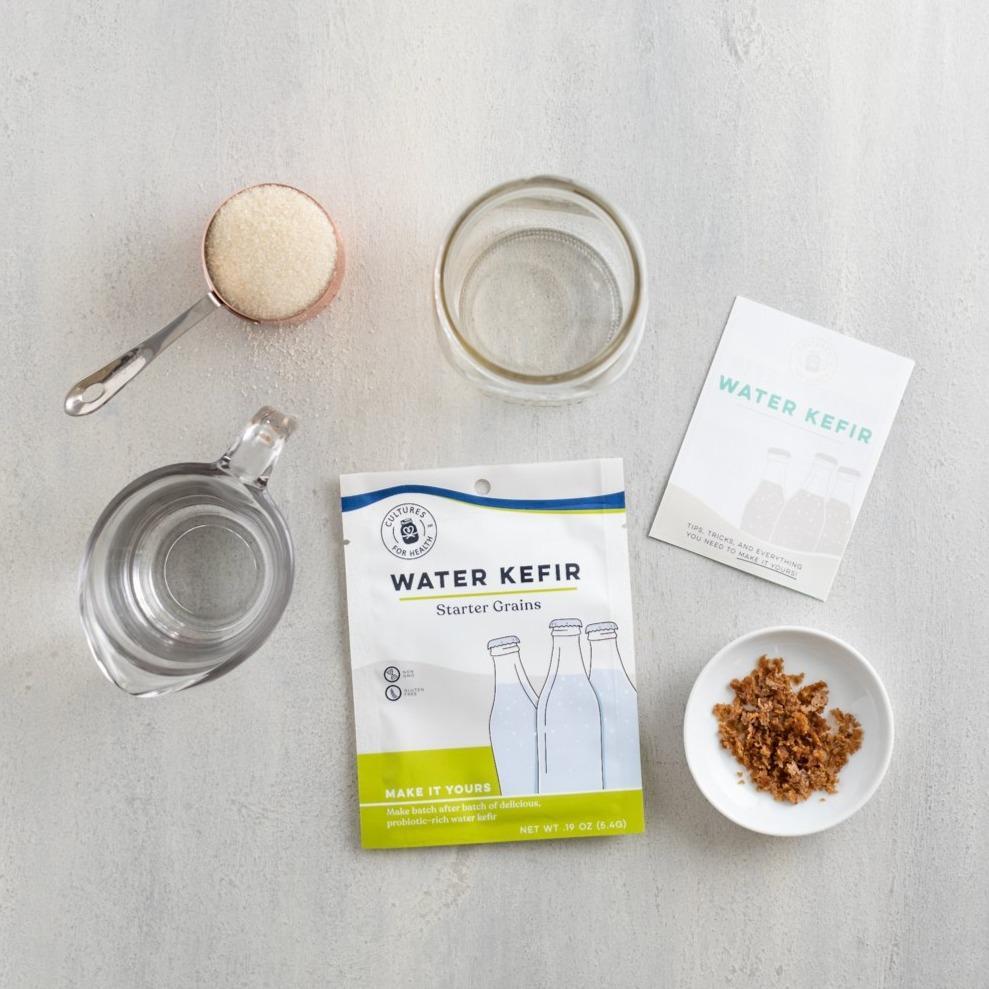
Water kefir is a probiotic beverage made with water kefir grains. Water kefir grains can be used to culture sugar water, juice, or coconut water. A powdered Kefir Starter may also be used to culture coconut water or fruit juice.
WHAT ARE WATER KEFIR GRAINS?
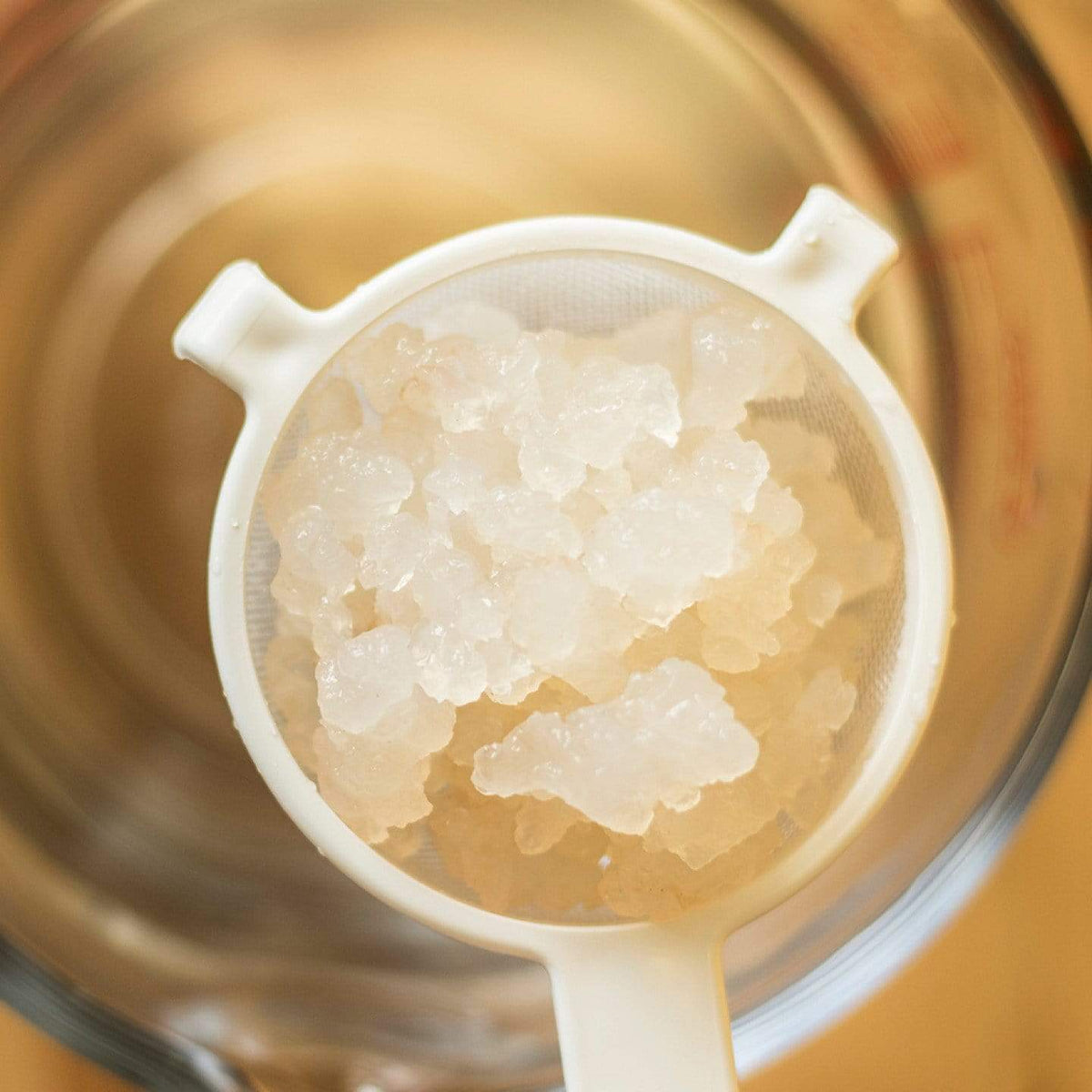
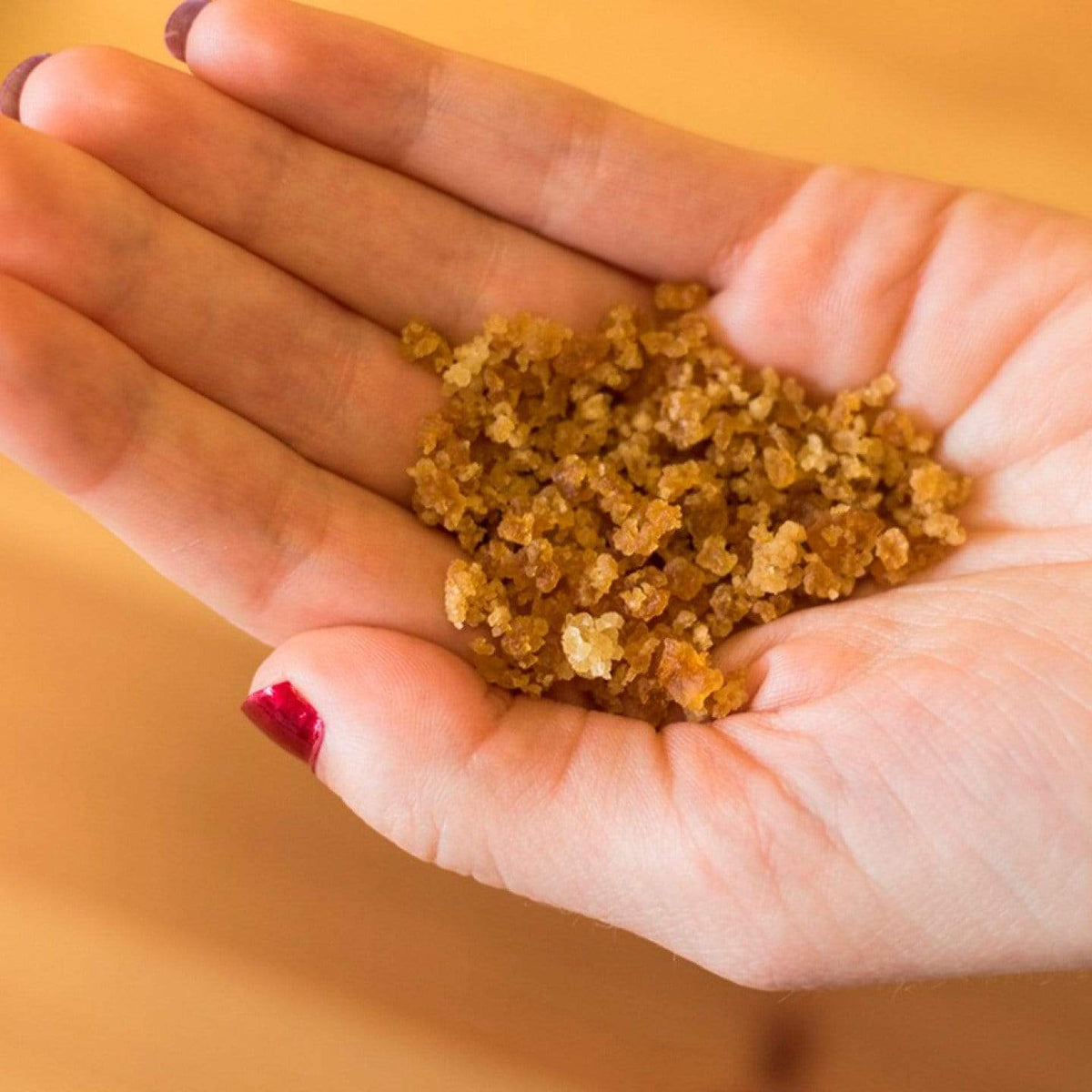
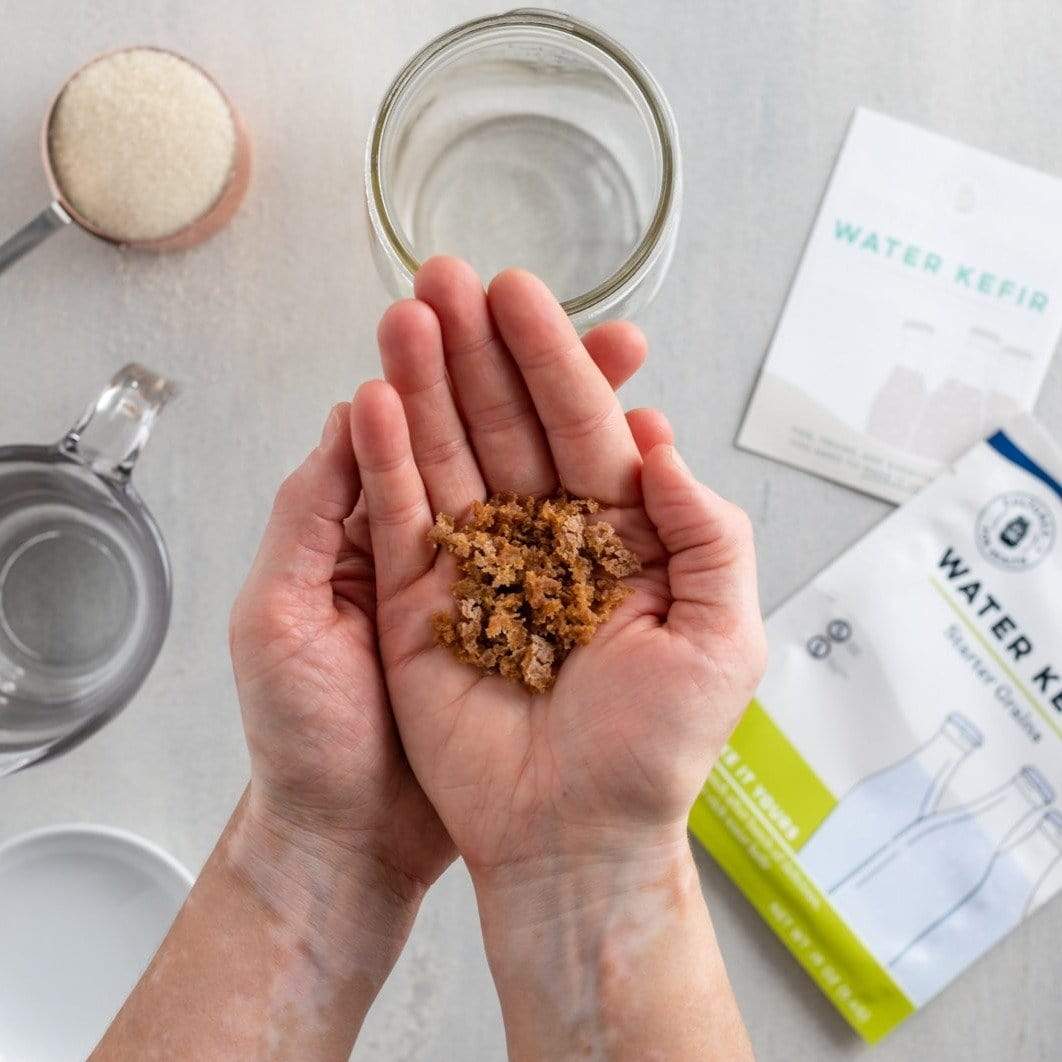
Water kefir grains consist of bacteria and yeast existing in a symbiotic relationship. The term "kefir grains" describes the look of the culture only. Water kefir grains contain no actual "grains" such as wheat, rye, etc.
WHAT IS THE DIFFERENCE BETWEEN WATER KEFIR GRAINS AND POWDERED KEFIR STARTER CULTURE?
There are three primary differences between water kefir grains and powdered kefir starter:
- Water kefir grains have a larger number of probiotics than powdered starter culture.
- With proper care, water kefir grains can be used indefinitely to make water kefir. Powdered starter culture can be reused for a number of batches, but will eventually stop culturing.
- Powdered kefir starter culture has a smaller initial investment cost than do water kefir grains; however, you will need to continue to purchase new culture.
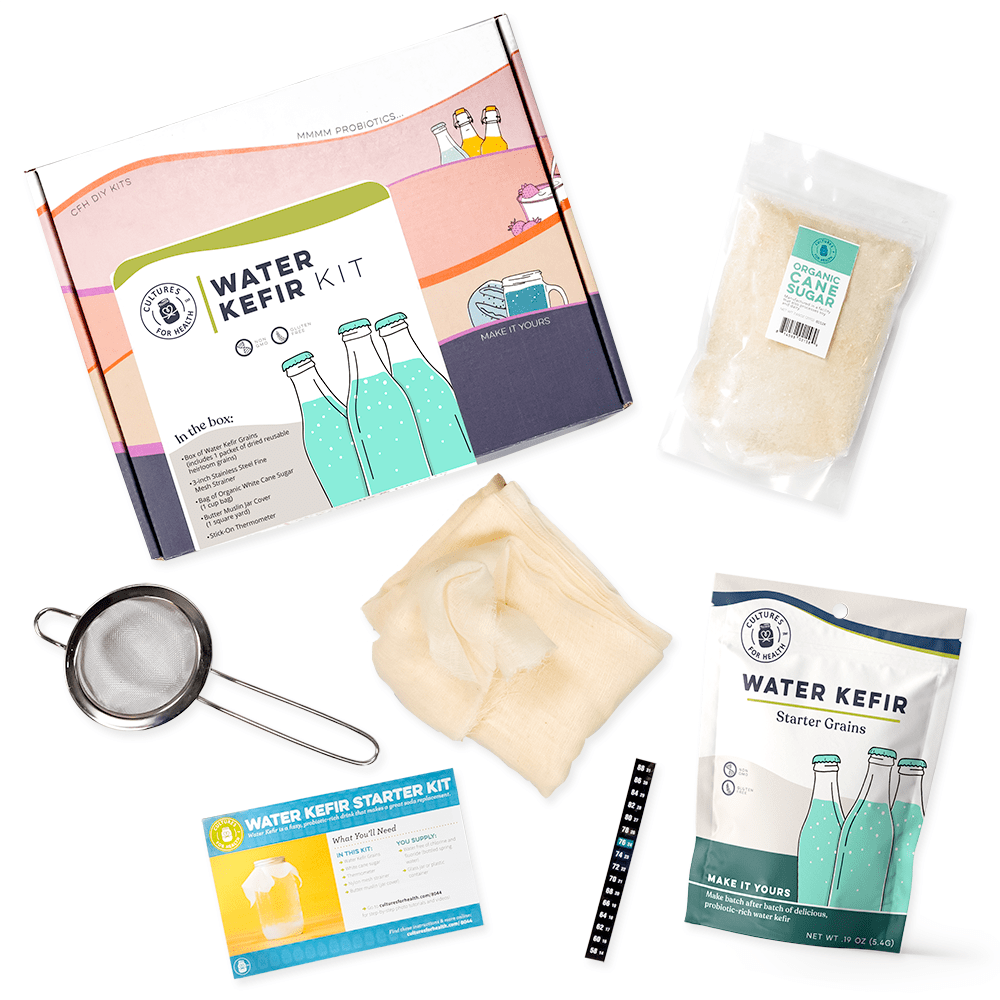
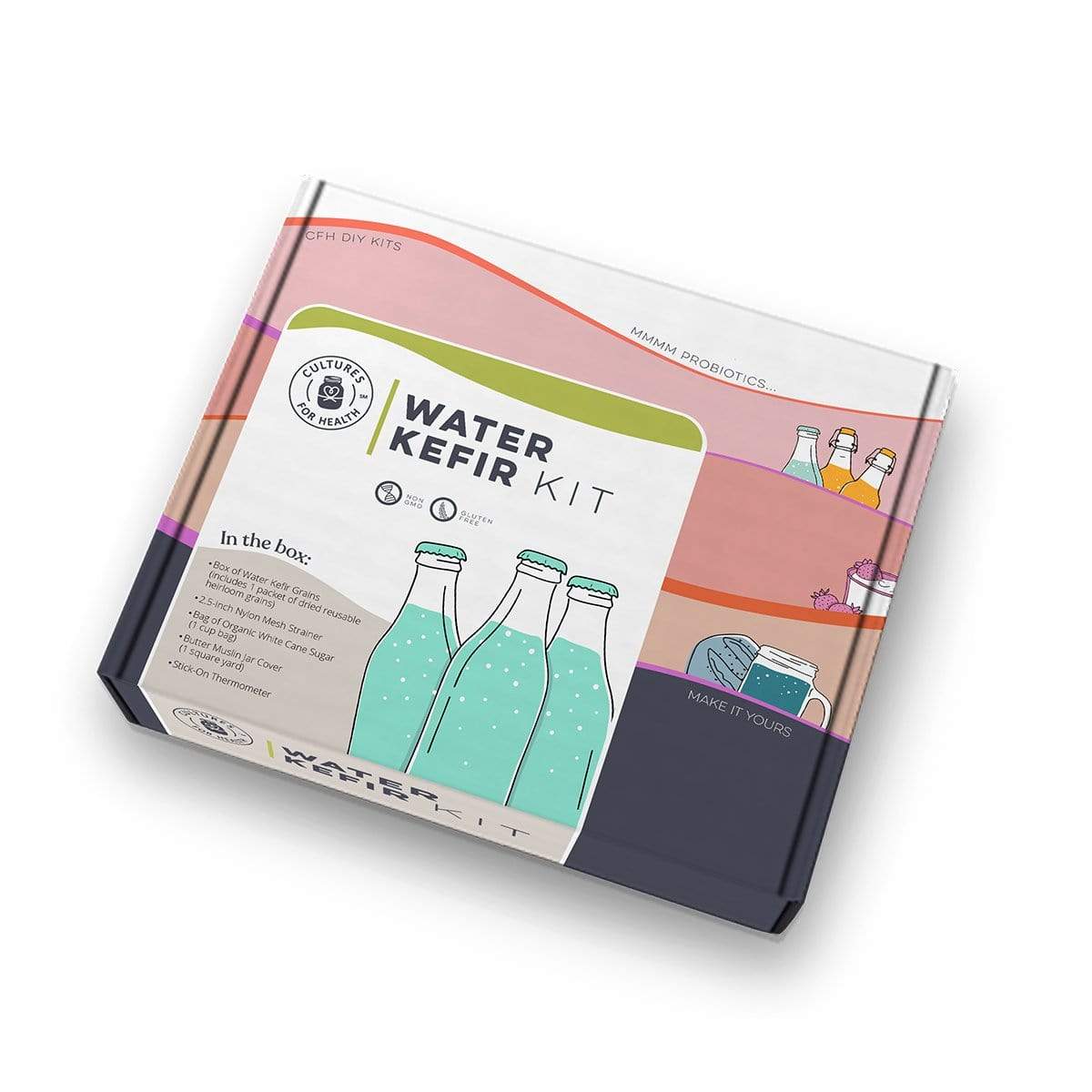

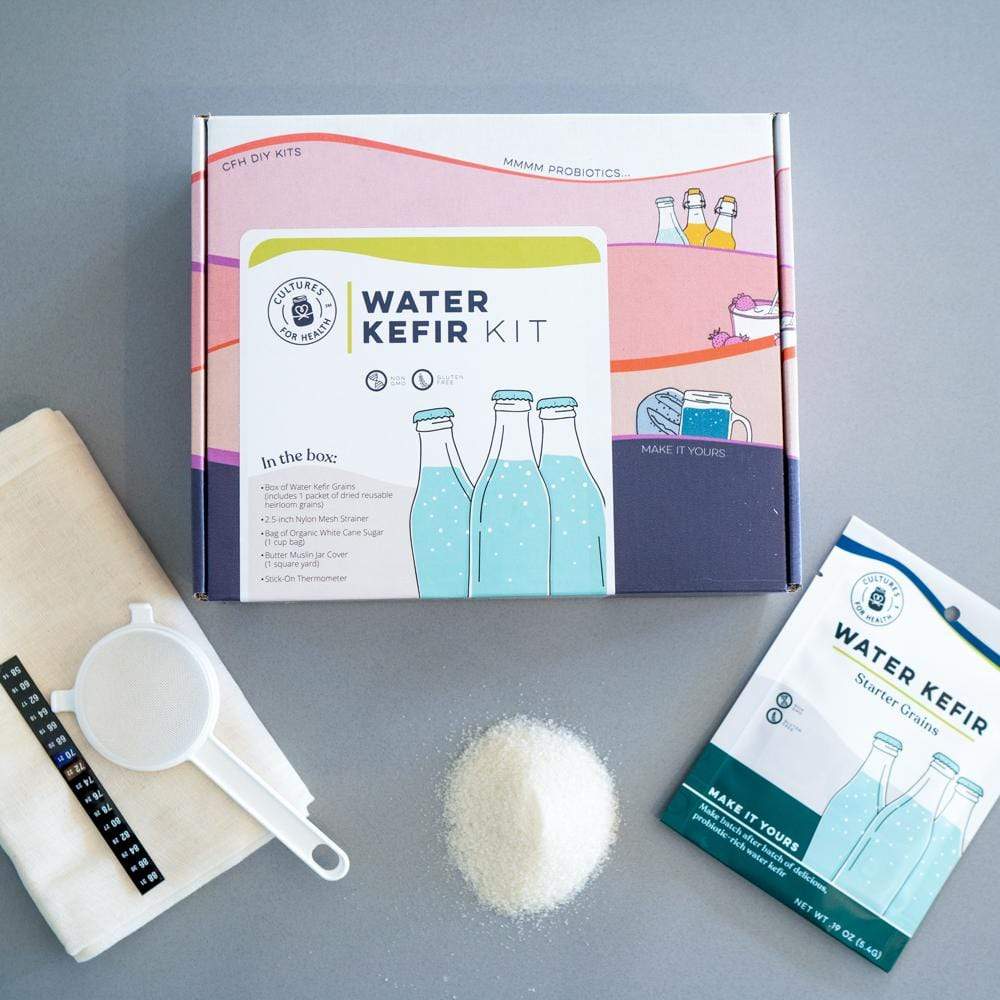
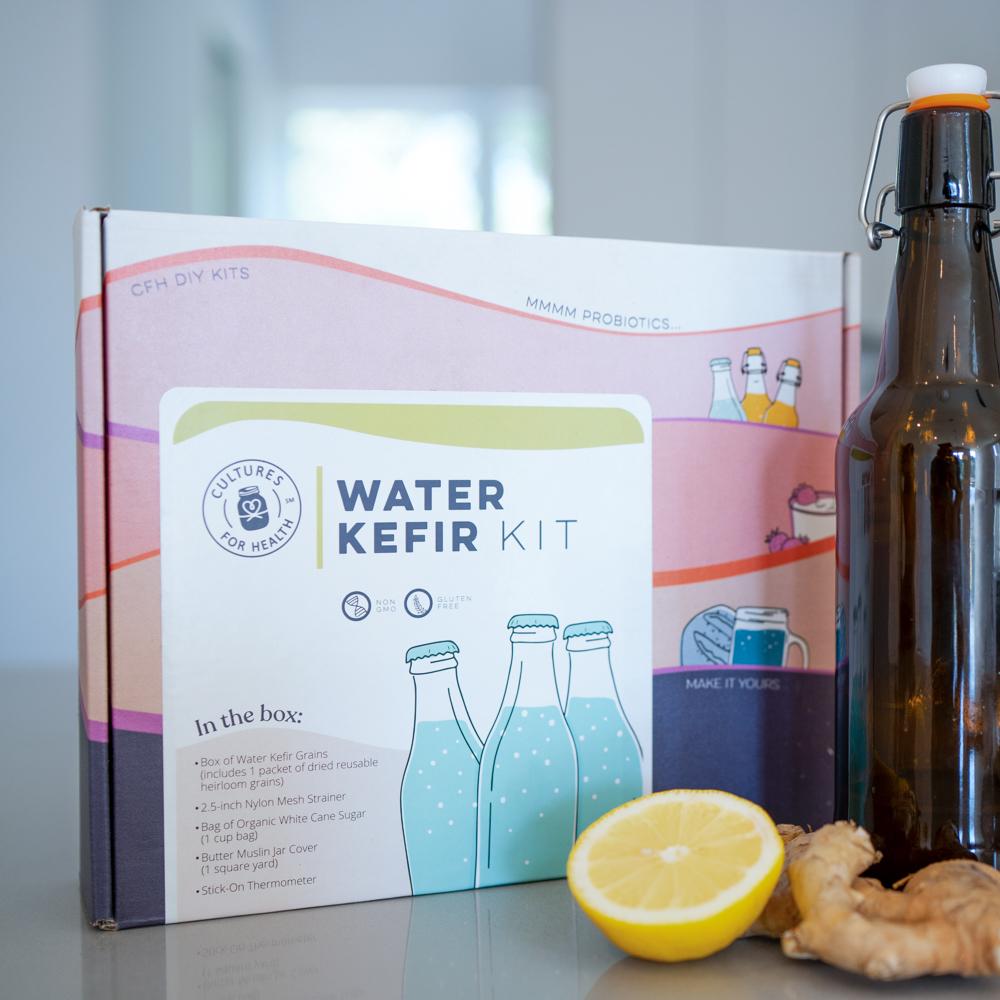



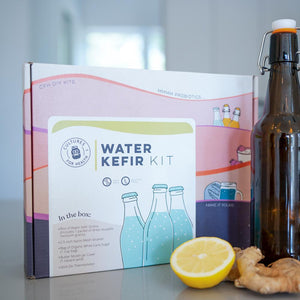
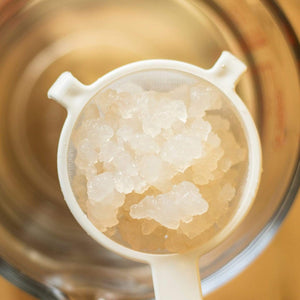
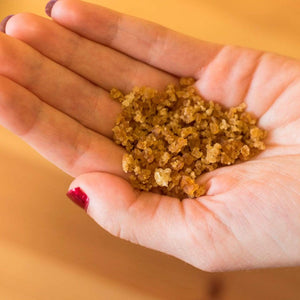


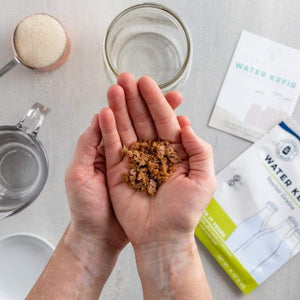
Water Kefir Starter Kit
WHAT INGREDIENTS GO INTO MAKING WATER KEFIR GRAINS?
Our water kefir grains are grown in filtered water and organic sugar.
DOES WATER KEFIR HAVE THE SAME BENEFITS AS MILK KEFIR?
Water kefir contains fewer strains of bacteria and yeasts than milk kefir. On the other hand, water kefir contains far more than other cultured products, like yogurt or buttermilk.
WHAT STRAINS OF YEAST AND BACTERIA DOES WATER KEFIR CONTAIN?
While the probiotics can vary with each batch made with water kefir grains, a list of bacteria and yeasts generally found in water kefir grains can be found in our article, Composition of Water Kefir Grains: Bacteria & Yeasts.
For our powdered starter cultures, a list of ingredients can be found on each product page.
I WANT TO CONSUME MILK KEFIR BUT I'M ALLERGIC TO DAIRY. IS WATER KEFIR A GOOD ALTERNATIVE?
Yes! Water kefir contains no dairy and are grown in filtered water and organic sugar.
DOES WATER KEFIR CONTAIN GLUTEN?
No, water kefir grains do not contain gluten.
ARE WATER KEFIR GRAINS REUSABLE?
Yes, water kefir grains are reusable. Once a batch of water kefir is finished culturing, simply remove the water kefir grains and place them in fresh sugar water, juice, or coconut water. (Although reusable, it is not advisable to use your only set of grains in juice/coconut water, as this can be very hard on them. It's best to use a separate set of grains.)
The powdered kefir starter culture may also be resued several times. Simply follow the instructions for Making Kefir with a Direct-Set Starter Culture.
HOW LONG DO WATER KEFIR GRAINS LAST? HOW LONG DOES A POWDERED KEFIR STARTER CULTURE LAST?
If cared for properly, water kefir grains have an unlimited life span and can be used repeatedly to make water kefir.
Kefir made with a powdered kefir culture (direct-set) can often be recultured from 2-7 times. The exact number of successive batches will depend on the freshness of the kefir and hygienic practices employed.
WHAT IS THE PROCESS FOR MAKING WATER KEFIR?
Water kefir can be made using a starter culture or reusable water kefir grains. You find instructions for each method below:
CAN I REHYDRATE THE WATER KEFIR GRAINS LONGER THAN THE RECOMMENDED 3-4 DAYS?
We strongly recommend moving the water kefir grains to fresh sugar water after four days, maximum. The grains can starve if left longer without fresh food.
CAN I DRINK THE SUGAR WATER USED TO REHYDRATE MY WATER KEFIR GRAINS?
We don't recommend drinking the rehydration liquid. Since the water kefir grains spent their time rehydrating rather than consuming the sugar, the resulting solution will likely contain a large amount of sugar. Also, the sugar water may taste unpleasant, as part of the rehydration process involves the rebalancing of the yeast and bacteria that comprise the water kefir grains.
HOW LONG DOES IT TAKE TO MAKE WATER KEFIR?
Water kefir generally takes 24-48 hours to culture. The exact time will vary depending on environmental factors, the most important of which is temperature. Allowing the water kefir grains to culture for longer than 48 hours puts you at risk of starving the grains and potentially damaging them.
MY HOUSE IS COLDER THAN 68ºF, HOW CAN I CULTURE WATER KEFIR?
Many homes maintain temperatures that are cooler, especially in the winter. For tips on keeping cultures within proper temperature range, see our article, Cold Weather Care for Starter Cultures.
HOW WILL I KNOW IF I'VE SUCCESSFULLY MADE WATER KEFIR? HOW DO I KNOW IF I SHOULDN’T DRINK IT?
If your grains are working, the liquid may lighten in color and turn cloudy. The flavor may become less sweet and it may have a slightly tangy or sour aroma and flavor. If your water kefir ever looks, smells, or tastes unpleasant, we always recommend that you refrain from consuming it.
WHAT DOES WATER KEFIR TASTE LIKE?
The taste of finished water kefir varies greatly, depending on the sugar used and the culturing time. Water kefir can be fairly sweet and may have a flat taste unless bottled. Most people prefer to add flavoring to water kefir before consuming.
HOW LONG CAN I STORE THE WATER KEFIR IN THE REFRIGERATOR?
Finished water kefir can be stored as follows:
- At room temperature (68° to 78°F): 3 to 4 days
- In the refrigerator (40° to 45°F): 2 to 3 weeks
- In the freezer (0° to 25°F): 1 to 2 months or longer
- Storage recommendation: Refrigerate
WHAT AMOUNT OF WATER KEFIR GRAINS DO I NEED TO MAKE WATER KEFIR?
To culture 1-2 quarts water kefir, use 3-4 tablespoons of hydrated water kefir grains.
DO I NEED TO RINSE THE WATER KEFIR GRAINS OFF BETWEEN BATCHES?
No. There is no need to rinse the water kefir grains between batches, and regular rinsing may be detrimental to the health of the water kefir grains.
DO I NEED TO WASH THE JAR/CONTAINER BETWEEN BATCHES OF KEFIR?
We recommend using a clean container for each batch of water kefir.
CAN I USE A PLASTIC CONTAINER TO BREW WATER KEFIR AND PLASTIC BOTTLES TO STORE IT?
Theoretically food-grade plastic shouldn't cause any damage to the culture but we always recommend glass when working with starter cultures, due to the potential of plastic to leach undesirable chemicals.
HOW CAN I FLAVOR WATER KEFIR?
There are endless ways to flavor water kefir. Our Ginger Water Kefir Kit includes everything you need to make ginger flavored water kefir at home. For more detailed instructions on flavoring water kit kefir, watch our How-To Video on How to Flavor Water Kefir.
CAN I ADD FLAVORING TO WATER KEFIR WHILE IT'S CULTURING?
We do not recommend adding fruit or other flavoring to the water kefir with the grains. Some fruits and other flavoring may be damaging to the water kefir grains.
CAN I USE JUICE TO MAKE WATER KEFIR?
Yes, some fruit juices can be used to make water kefir. However, using water kefir grains in juice and then moving them to sugar water may result in unpleasant-tasting water kefir. We recommend maintaining two sets of water kefir grains instead, one for juices and one for sugar water. Alternately, add juice as flavoring after the grains have been removed.
CAN I USE COCONUT WATER TO MAKE WATER KEFIR?
Yes, coconut water can be used to make water kefir. Before getting started, make sure your grains are fully hydrated and have been culturing in sugar water for at least 3 weeks prior to using coconut water. Alternate coconut water batches with sugar water batches to keep the grains healthy.
CAN I USE HONEY TO MAKE WATER KEFIR?
We do not recommend using honey to make water kefir.
WHAT TYPE OF SUGAR SHOULD I USE TO MAKE WATER KEFIR?
A number of kinds of sugar can be used to make water kefir, however, we do not recommend making water kefir with honey, molasses, or sugar substitutes like agave, stevia, monk fruit, or Splenda. These can either be damaging to water kefir grains or not provide them with the proper "food" to survive. Consult our tutorial Choosing Ingredients for Making Water Kefir for more information.
DO I NEED TO ADD SUGAR IF I'M USING JUICE TO MAKE WATER KEFIR?
No, there should be enough sugar in the juice to feed the water kefir grains.
HOW MUCH SUGAR DOES FINISHED WATER KEFIR CONTAIN?
The remaining sugar in finished water kefir will vary depending on ingredients used and culturing conditions. Generally speaking, water kefir cultured for 48-hours will result in less remaining sugar than water kefir cultured 24-hours under similar conditions.
WHAT TYPE OF WATER SHOULD I USE TO MAKE WATER KEFIR?
Use water as free from contaminants as possible, for the health of the water kefir grains. For more information, consult our article, Choosing Ingredients for Making Water Kefir.
HOW MUCH ALCOHOL DOES WATER KEFIR CONTAIN?
As with all cultured and fermented foods, a small amount of naturally occurring alcohol is typically present in the finished product. Although the amount will vary from batch to batch, for the typical brewing period, the amount should be quite low.
CAN I USE WATER KEFIR GRAINS TO MAKE ALCOHOL?
Yes. Culturing water kefir grains in 100% juice (especially with added sugar) for several days will result in a higher alcohol content. Also, it is possible to make a type of beer using water kefir grains.
WILL WATER KEFIR GRAINS MULTIPLY?
Water kefir grains are known to multiply, but at times they are reluctant to do so. Even if they do not multiply, with proper care, water kefir grains can be used repeatedly to brew water kefir. For more information, consult our article, Encouraging Water Kefir Grains to Multiply.
WHAT SUPPLIES DO I NEED TO MAKE WATER KEFIR?
Making water kefir does not require any specialized equipment. The Water Kefir Starter Kit includes everything you need to get started aside from a glass jar and water. Read our tutorial How to Make Water Kefir for more information.
CAN I USE A METAL STRAINER WITH MY WATER KEFIR GRAINS?
While a plastic mesh strainer is preferred, stainless steel is acceptable. Avoid all other types of metal when working with water kefir grains.
HOW DO I TAKE A BREAK FROM MAKING WATER KEFIR?
Detailed instructions can be found in our article How to Take A Break from Making Water Kefir.
IF I’M MAKING OTHER CULTURED FOODS (YOGURT, SOURDOUGH, KOMBUCHA, ETC.), HOW FAR APART DO I NEED TO KEEP THE WATER KEFIR CULTURE?
We suggest a distance of at least 4 feet between cultures. When stored in the refrigerator with a tight-fitting lid, there is no need to keep distance between cultures.
Check to know more about kombucha prices.
MY WATER KEFIR GRAINS ARE MULTIPLYING RAPIDLY. IS THERE A POINT AT WHICH I MUST REMOVE SOME OF THE GRAINS?
We recommend using 3-4 tablespoons of water kefir grains to culture 1-2 quarts of sugar water. More grains cause the culturing process to progress very quickly, so it is best to remove any amount above 4 tablespoons, to avoid over-culturing and to impart the best flavor.
Extra water kefir grains can be used to culture another jar of water kefir, shared with friends, eaten, blended into smoothies, or dried and stored in a sealed container in the fridge as backup.
CAN I KEEP MY WATER KEFIR GRAINS IN A BAG INSTEAD OF LETTING THEM FLOAT FREE?
The water kefir grains may be contained in a muslin bag. Be sure the bag is submerged in the sugar water. If it floats it can mold.
SHOULD I ADD THINGS LIKE GINGER JUICE, EGGSHELL, AND BAKING SODA TO MY WATER KEFIR GRAINS TO KEEP THEM HEALTHY?
If you are using a quality water and sugar source, additives should not be necessary.
START USING WATER KEFIR AT HOME
Cultures for Health is here to help you to start using water kefir at home with the largest selection of fermentation and culture starters in the world. The best deal you can get when starting out is our Water Kefir Starter Kit.
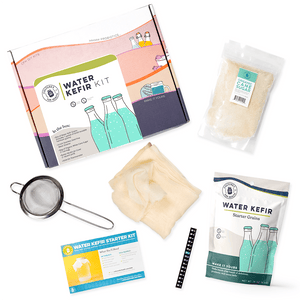
This Water Kefir Kit not only comes with a box of water kefir grains but it also comes pre-packed with 4 hand-picked supplies to get you started. In this Water Kefir Kit you get:
- 1 - Box of Water Kefir Grains (includes 1 packet of dried reusable heirloom grains)
- 1 - 2.5-Inch Nylon Mesh Strainer
- 1 - Bag of Organic White Cane Sugar (1 cup bag)
- 1 - Butter Muslin Jar Cover (1 square yard)
- 1 - Stick-On Thermometer
On top of all of that, we have a team that is here to help you around the clock with any questions or issue you may have.
Click here to check out our Water Kefir Starter Kit now!
Start learning about the benefits of water kefir and where to buy water kefir grains! Download our free Water Kefir Guide and Recipe book today!