
- Welcome, Guest! (Log In)
- View Cart
- Contact Us
- 1-800-962-1959
Details
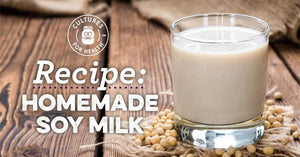
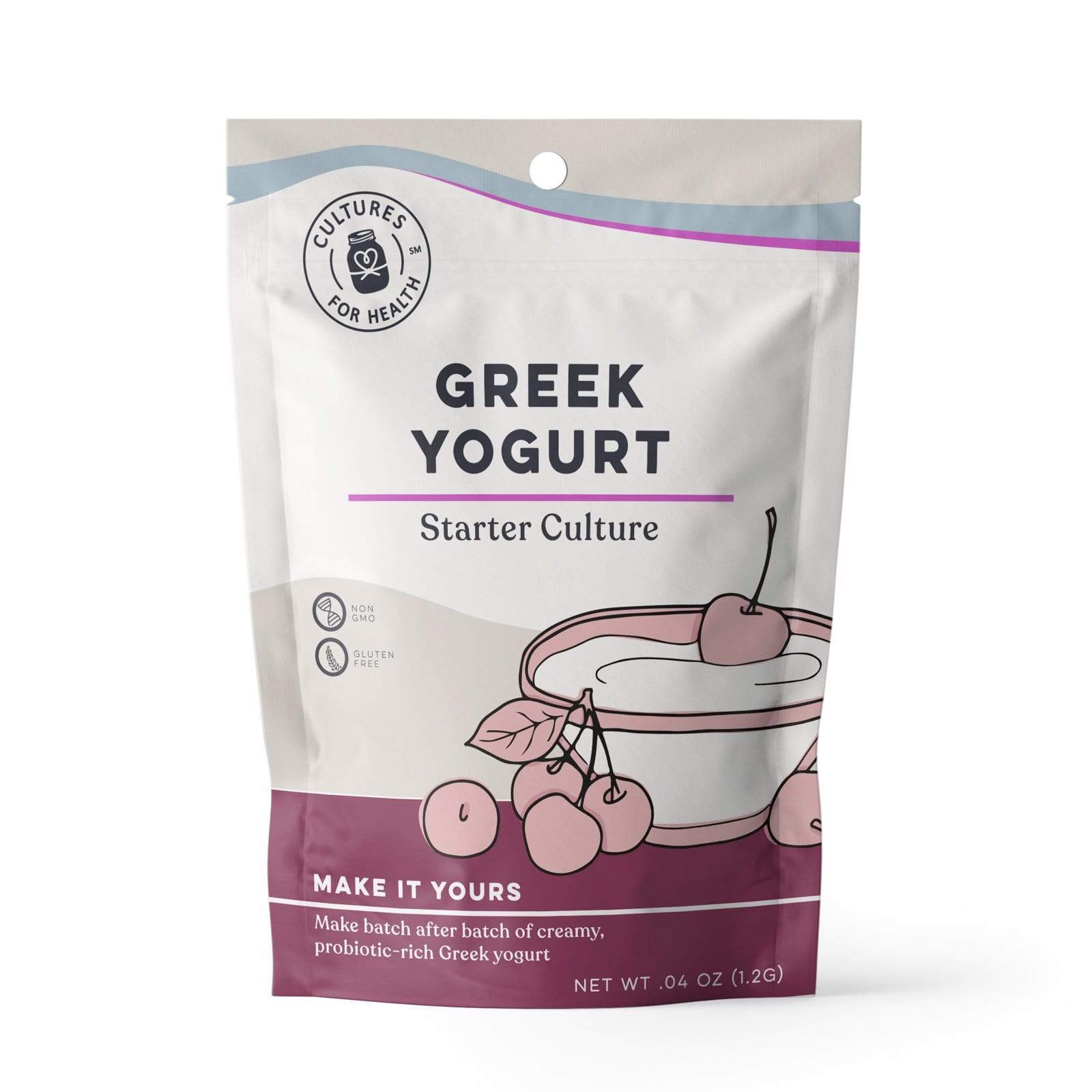
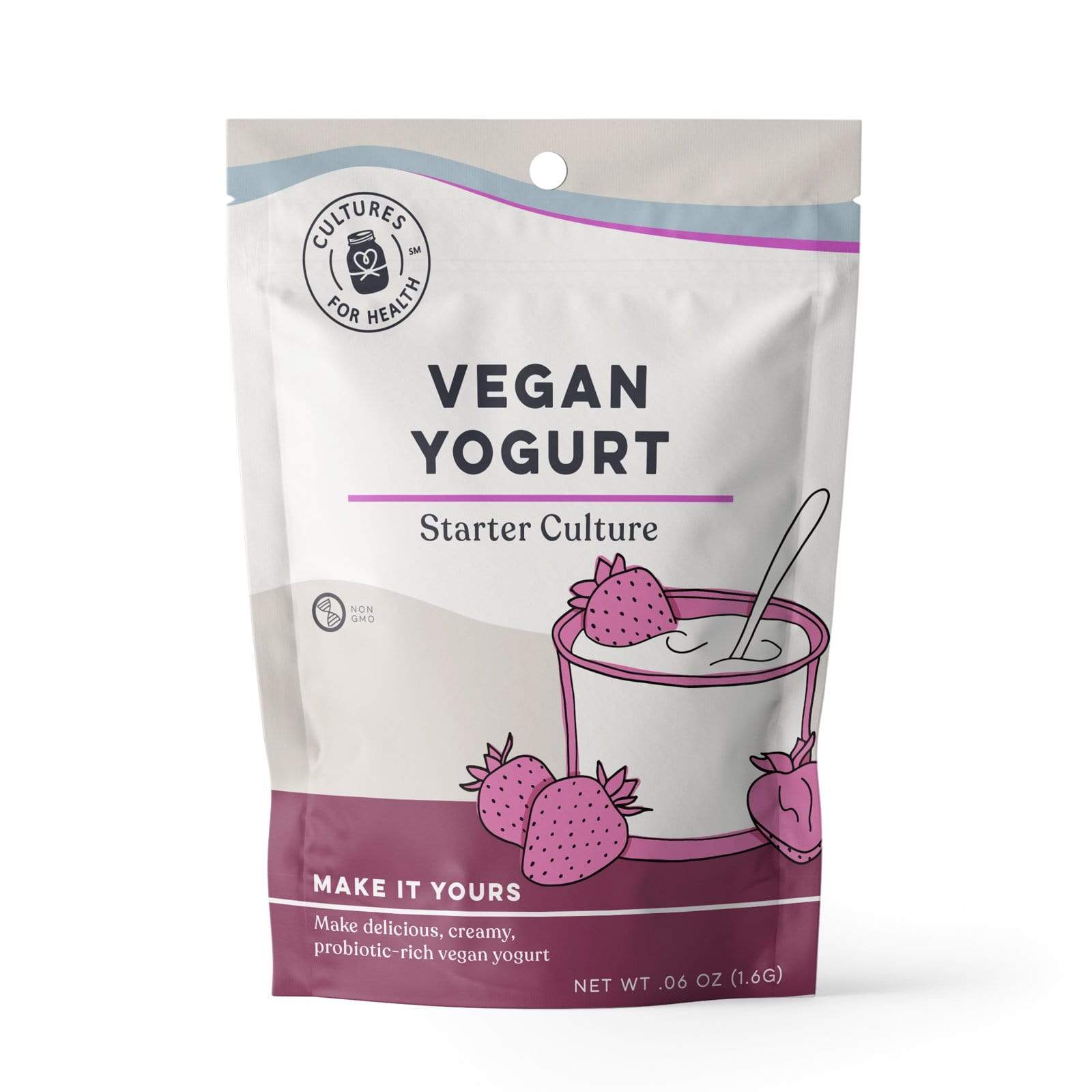
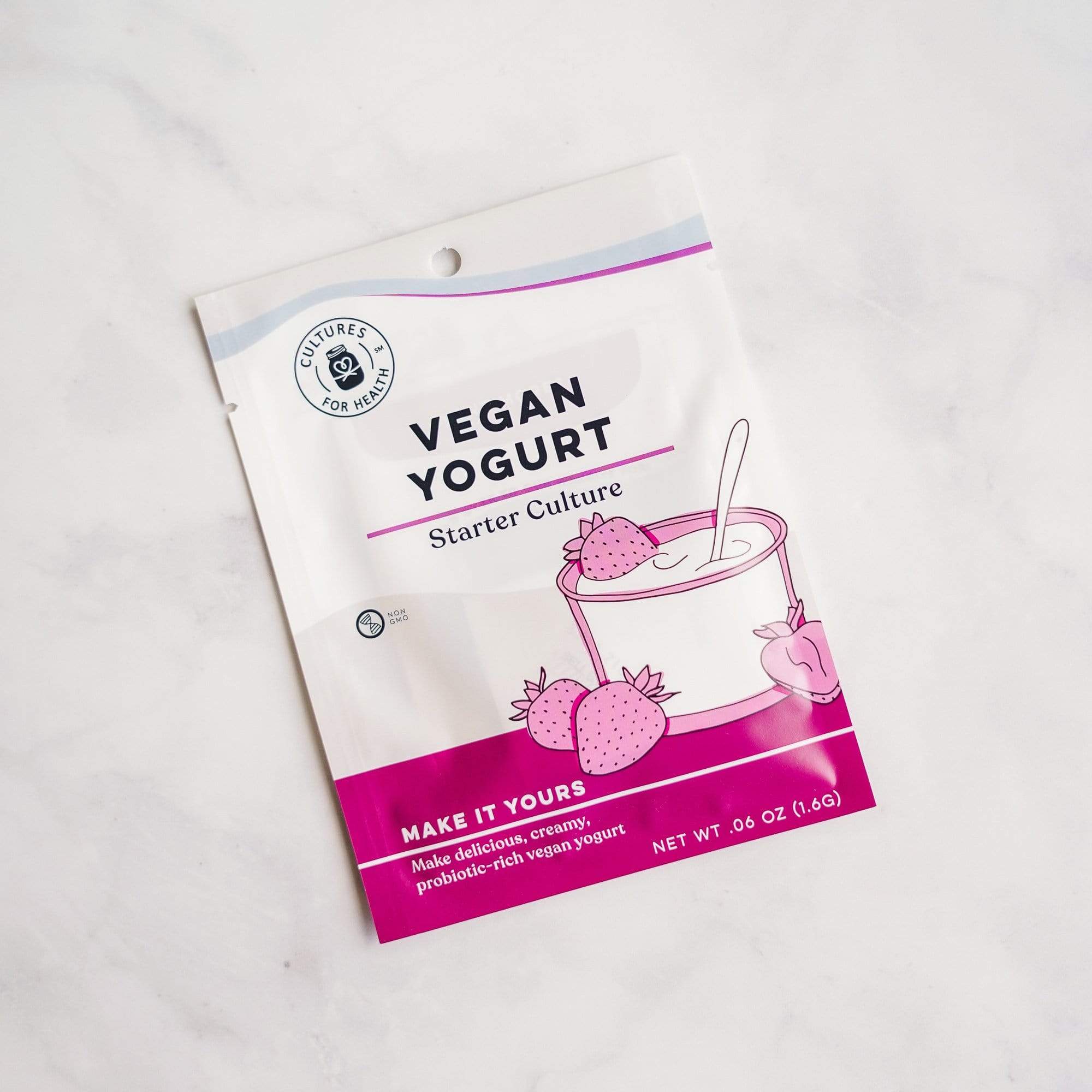
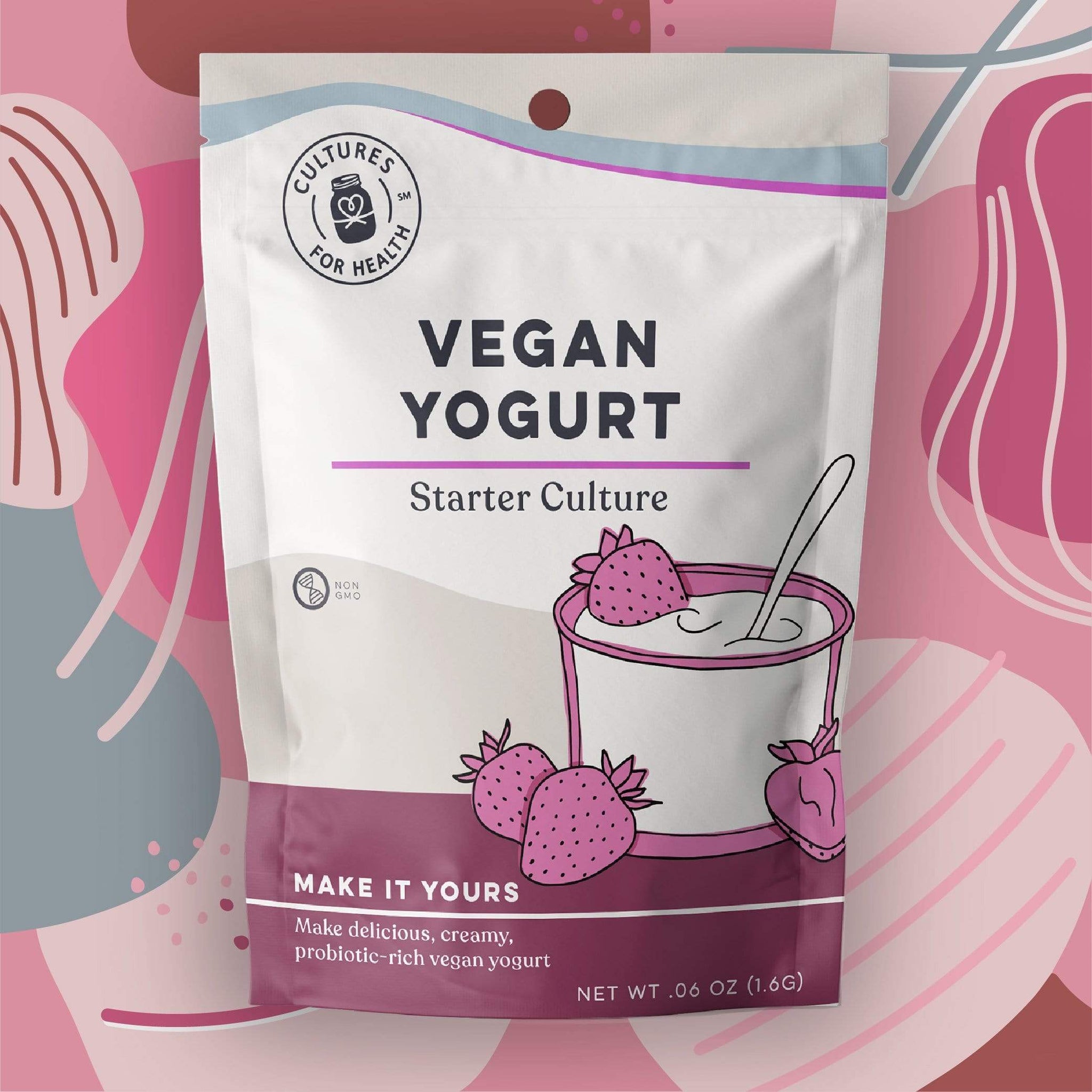
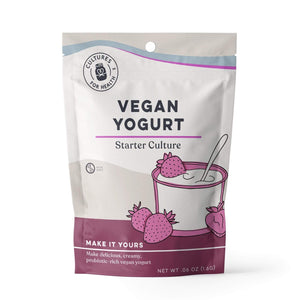
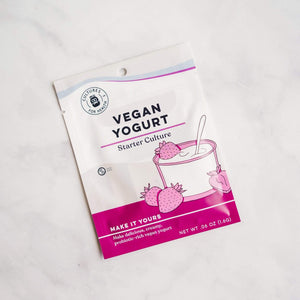
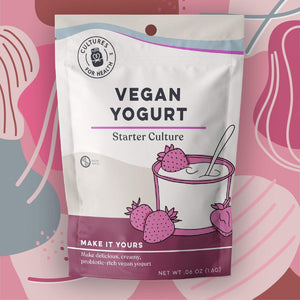
A blend of lactic acid bacteria specifically selected for use in making dairy-free yogurt. This culture has a mild yogurt flavor with a smooth texture and slightly weak viscosity. Ideally suited for soy or rice milk.
This is a direct-set yogurt starter and cannot be recultured (see below).
- Vegan non-GMO Yogurt Starter
- For use with non-traditional milks such as soy milk, rice milk, and nut milks. (Please note, while rice milk and nut milks can be cultured, they often won't thicken and additional thickening agents may be needed to obtain a yogurt-like consistency.)
- Requires a yogurt maker or similar heating appliance
- Direct-set yogurt starter
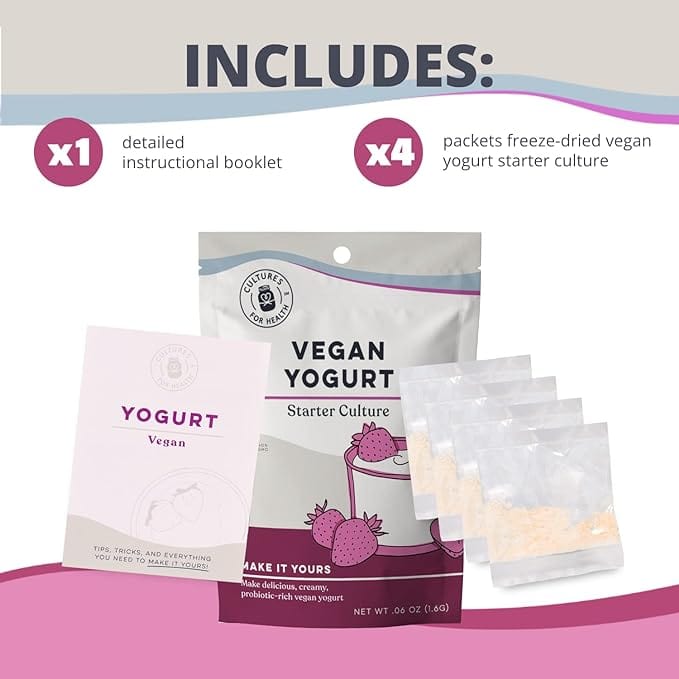
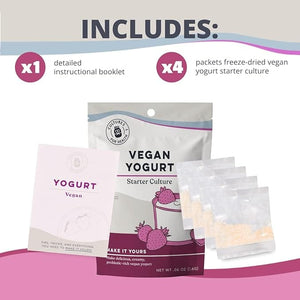
- Contains 8 packets; each packet makes 1-2 quarts yogurt
Instructions: Add one packet per 1 to 2 qts non-dairy milk (soy, rice, etc.) and incubate at 108°F for 6-8 hours or until the mix has formed a smooth creamy texture. Chill immediately to below 70°F to halt the culturing process. Continue to cool overnight in the refrigerator or simply mix in any desirable flavors and enjoy. If larger quantities of yogurt are desired, two packets can be added to 1 - 4 gallons of non-dairy milk.
Please note, while rice milk and nut milks can be cultured, they often won't thicken and additional thickening agents may be needed to obtain a yogurt-like consistency.
Ingredients: Rice maltodextrin, live active bacteria (Bifidobacterium bifidum, Lactobacillus acidophilus, Lactobacillus casei, Lactobacillus delbrueckii subsp bulgaricus, Lactobacillus rhamnosus, Streptococcus thermophilus)
Vegetal does not consist of, nor does it contain, nor is it produced from genetically modified organisms.
Produced or packaged in a facility that also manufactures products made with wheat, dairy, soy, eggs, nuts, and fish.
What is a Direct-Set culture? Direct-Set cultures are a one-time-use culture, they cannot be recultured (i.e. perpetuated beyond the single batch). Direct-Set cultures require no maintenance or care. Simply keep the packet in the freezer and remove the portion for your recipe when it's time to make yogurt. Most Direct-Set cultures contain multiple doses to inoculate multiple batches.
Questions on Vegan Yogurt Starter
- From Shelby at 4/13/11 1:24 PM
- If I were to use homemade brazil nut milk (straining out the pulp), will this suffice for making the yogurt with this starter? Or do I need to add some kind of sugar to feed the cultures (and which sugars do u recommend: raw honey? blackstrap molasses? ....?)?
Also, how long should I incubate with brazil nut milk? Are there other milks u recommend, either homemade or store-bought?(I cannot do soy)
Would I also need to add a thickener, like xantham gum, arrowroot, gelatin, or guar gum? If so, which do u recommend (health-wise and "performance"-wise)?
If honey is suggsted as the sugar to feed the cultures, won't this actually kill the cultures, since raw honey is anti-bacterial?
Thanks!!! Can't wait to try this! - We don't recommend that you add anything to the milk you use as you culture it - whether it is nut milk, grain milk, or dairy milk. The culture generally works best on the basic milk, without added sugars or stabilizers. If you want to add things after you culture it, there are many great sugars you can try depending on your tastes and preferences. Brazil nut milk would be a good base for yogurt, because of the high fat content. For added thickness, agar agar might be a good choice. It is a seaweed-based "gelatin" that is available in many Asian markets, or sometimes in the "Asian Foods" section of a supermarket. You would add the agar agar after culturing.
- Do you find this question helpful? Yes No
- If I were to use homemade brazil nut milk (straining out the pulp), will this suffice for making the yogurt with this starter? Or do I need to add some kind of sugar to feed the cultures (and which sugars do u recommend: raw honey? blackstrap molasses? ....?)?
- From Shelby at 4/13/11 1:51 PM
- Just a warning:
Vegetal DOES contain barley. I called the company and it is grown on soy and barley, but it supposedly such trace amounts that it is allowed to be called "gluten-free" in the US.
Just wanted to let people know in case they were extremely sensitive to gluten. - Thank you Shelby!
- Do you find this question helpful? Yes No
- Just a warning:
- From Shelby at 4/24/11 7:19 PM
- Some recipes say to heat the milk (non dairy) to 160 to kill off any bad bacterial, then let it cool to 110 or so. is this necessary?
- It's possible to make yogurt out of alternative milks by only heating it up to culturing temperature, but heating it to 160 first does a couple of things. First, it ensures that the milk is "clean" and free of any bacteria that might compete with the yogurt cultures. Second, the process of heating the milk breaks down the proteins and helps make the resulting yogurt a little thicker.
- Do you find this question helpful? Yes No
- From Jillian at 4/28/11 3:19 PM
- How long does the non-dairy yogurt last or store in the refrigerator for prior to going bad?
- There might be some variation depending on how cold your refrigerator is, how well the product is covered, how frequently you open the refrigerator door, etc. In general, these kinds of products stay good for about a week to ten days. As always, we advise that you not consume anything that looks, smells, or tastes bad.
- Do you find this question helpful? Yes No
- From Rose at 5/25/11 2:53 PM
- Hello. Are your cultures isolated from a plant source? Do they contain any yeast, or are they grown on yeast? What plants or other things (other than soy) are your starters cultured on? Thanks!
- This product is grown on non-GMO barley and soy. There is no yeast.
- Do you find this question helpful? Yes No
- From kate hoag at 5/25/11 4:02 PM
- How much longer does coconut milk take to culture? My son was just allergy tested and has sensitivities to soy,cow dairy. I've attempted yogurt, and it is too runny. Any help would be very appreciated. Thanks!!
- The Vegetal yogurt starter used with alternative milks does produce a runnier yogurt than what you might be used to from the store. The yogurt should take around 6-8 hours to set up. Make sure you are using full-fat coconut milk without any additives. (Guar gum is hard to avoid, and seems to be okay in culturing.) You can increase thickness after culturing by adding agar (a type of seaweed).
- Do you find this question helpful? Yes No
- From Janet at 6/9/11 9:51 PM
- I read on your site that a direct set culture means it cannot be recultured. Does that mean I cannot save some of the yogurt that I make to use it for the next batch as I can with dairy yogurt?
Could this be made with potato milk? The one that I use is Vance's Darifree (www.vancesfoods.com/darifree.htm). I am not sure if there are any other potato milks out there? - You are correct in that the Vegetal culture is not viable for reculturing, and a new inoculation must be made for each new batch of yogurt.
It may work with potato milk - we don't have any experience with that. It does work with rice milk, which would have a similar composition. We would be happy to hear of your experience with this. - Do you find this question helpful? Yes No
- I read on your site that a direct set culture means it cannot be recultured. Does that mean I cannot save some of the yogurt that I make to use it for the next batch as I can with dairy yogurt?
- From Virginia S. at 6/11/11 11:38 PM
- I have 2 questions concerning things you've written.
Firstly, if sugars feed cultures for growing, why do you recommend not adding any type of sugar, (for vegan nut-yogurt)? Secondly, why, chemically, isn't your starter possible for reculturing ?
.. thanks, .. Virginia - There are actually differing schools of thought on adding sugars to yogurt. Most yogurt cultures have developed in dairy milk environments, and work best with the naturally-occurring combination of fats, proteins, and sugars found in milk. Vegetal Dairy-Free Yogurt Starter has been specially formulated to culture non-dairy milks, but even so, results can be uneven because these are not technically milks, and yogurt fermentation is not a natural behavior for them.
Rice milk has a similar sugar profile to milk, and more sugar will not improve it for culturing. Soy milk and other grain milks are lower in sugar than dairy milk, and it is possible that you could improve fermentation by adding some sugar. Nut milks are particularly hard to culture because nuts are not fermentable. Again, adding sugar may help.
While the bacteria can, under ideal circumstances, ferment alternative milks into yogurt, the necessary nutrients to keep the bacteria alive (casein, lactose) are not present in the alternative milks, so the bacteria cease to be viable after they have cultured the "milk." - Do you find this question helpful? Yes No
- I have 2 questions concerning things you've written.
- From Les at 6/22/11 12:24 PM
- Two questions
1. Does the vegetal starter work with lactose free milk, like Lactaid?
2. How much powdered milk solid is in the dairy based yogurt starters? - The vegetal starter will not work with lactose-free milk, as there is no sugar for the yogurt bacteria to eat. It's possible that you might be able to add sugar to the LF milk and provide a culturing environment. However, the action of yogurt cultures is to eat up the lactose. When yogurt is cultured long enough, all the lactose is consumed.
We do not add powdered milk solids to our yogurt starters. The starters are dehydrated yogurt, containing the live bacteria. - Do you find this question helpful? Yes No
- Two questions
- From Hannah at 7/28/11 12:59 PM
- Hi, My daughter and I both have a milk allergy =( I would prefer to buy one of your reusable starters and make coconut milk yogurt. I like the idea of making a couple of batches so that the amount of cow's milk would be significantly reduced but noticed that you also said that using non-dairy milks makes the starter yogurt less reusable. How many times do you think I could successfully use a starter from a previous batch to culture a new batch? I'm especially wondering since my daughter and I wouldn't be able to eat the first couple of batches.
Thanks! - A reusable starter would not be a good choice for you, as they are dependent on dairy to reproduce. However, the Vegetal starter is especially formulated for non-dairy milks, and gives a good result with coconut milk.
- Do you find this question helpful? Yes No
- Hi, My daughter and I both have a milk allergy =( I would prefer to buy one of your reusable starters and make coconut milk yogurt. I like the idea of making a couple of batches so that the amount of cow's milk would be significantly reduced but noticed that you also said that using non-dairy milks makes the starter yogurt less reusable. How many times do you think I could successfully use a starter from a previous batch to culture a new batch? I'm especially wondering since my daughter and I wouldn't be able to eat the first couple of batches.
Ask Your Own Question
Back to the product pageCustomer Reviews
- The stuff works with a little patience and a lot of trial and error. Review by AVMom
-
This is my very first time making yogurt at home. I became a Vegan about 4 years ago and found the milk alternative yogurts on the market were expensive and mostly too sweet for my preference. Some containing as much as 19 grams of sugar per cup. I have recently purchased a yogurt maker and found this vegan yogurt starter and decided to give it a shot. My first 2 batches were a total loss. Too watery, soupy and tasteless. I contacted Customer Service and was guided to a few web articles that really helped me along the way. I have now made 2 successful batches of coconut yogurt!Quality Price Value
Thanks Cultures for Health, cheers to yours! (Posted on April 29, 2013)
- Excellent! Review by Chachi
-
Excellent product. I use it to make coconut yougurt and it gives me great results everyone loves the coconut yougurt I make! The price of the product is great and the shipping in timely.Quality Price Value
(Posted on January 14, 2013)
- Great Review by Alyssa
-
This is really easy to use and comes with very detailed instructions. I made coconut milk yogurt and it came out perfect! (Posted on January 13, 2013)Quality Price Value
- Excellent soy yogurt! Review by Chau
-
I got this starter for my aunt who makes soy yogurt for her casein intolerant daughter, and she tells me she is impressed with this product! She makes her own soy milk, and the yogurt made from it using this starter sets up really thick, just like regular yogurt! No additional thickener was needed. (Posted on October 10, 2012)Price Value Quality
- Great! Review by OnlyAnagram
-
I've made several successful batches of soy yogurt with this starter. I do add tapioca starch and agar powder in the process for the right consistency. The yogurt comes out tangy and delicious. (Posted on August 30, 2011)Price Value Quality
- great Review by Xue
-
I used this with coconut milk. I diluted the coconut milk too much and the final product was quite thin and watery (more watery than kefir), but the amaazing flavor made up for it--very tangy and absolutely delicious and really hit the spot. I was perfectly fine with that, but next time I will add gelatin -before- the starter (I added it after making the yogurt, and I don't think it did much). I'll also try this with almond milk. (Posted on July 31, 2011)Value Quality Price
- Awesome! Review by Sarah
-
This is awesome- works great with organic soy milk. I could not, however get it to work with rice milk. Mine turned out a little soupy as well(I think that's to be expected honestly), BUT I was able to get a nice thick, creamy consistency by straining it overnight in a colander lined with coffee filters placed over a bowl. (Posted on June 14, 2011)Price Value Quality
- Soy Yogurt Review by Himmy
-
Something tells me I didn't do something right. My yogurt came out very soupy. I'm going to try it again. Fingers crossed. (Posted on March 27, 2011)Value Quality Price
- Excellent Review by Laura
-
I made yogurt using Silk soy milk light (plain) and the yogurt turned out excellent. I added 1 tsp of agar powder before adding starter. The yogurt turned out excellent and much better than the soy yogurt I had been buying from the health food store.Value Quality Price
(Posted on March 20, 2011)