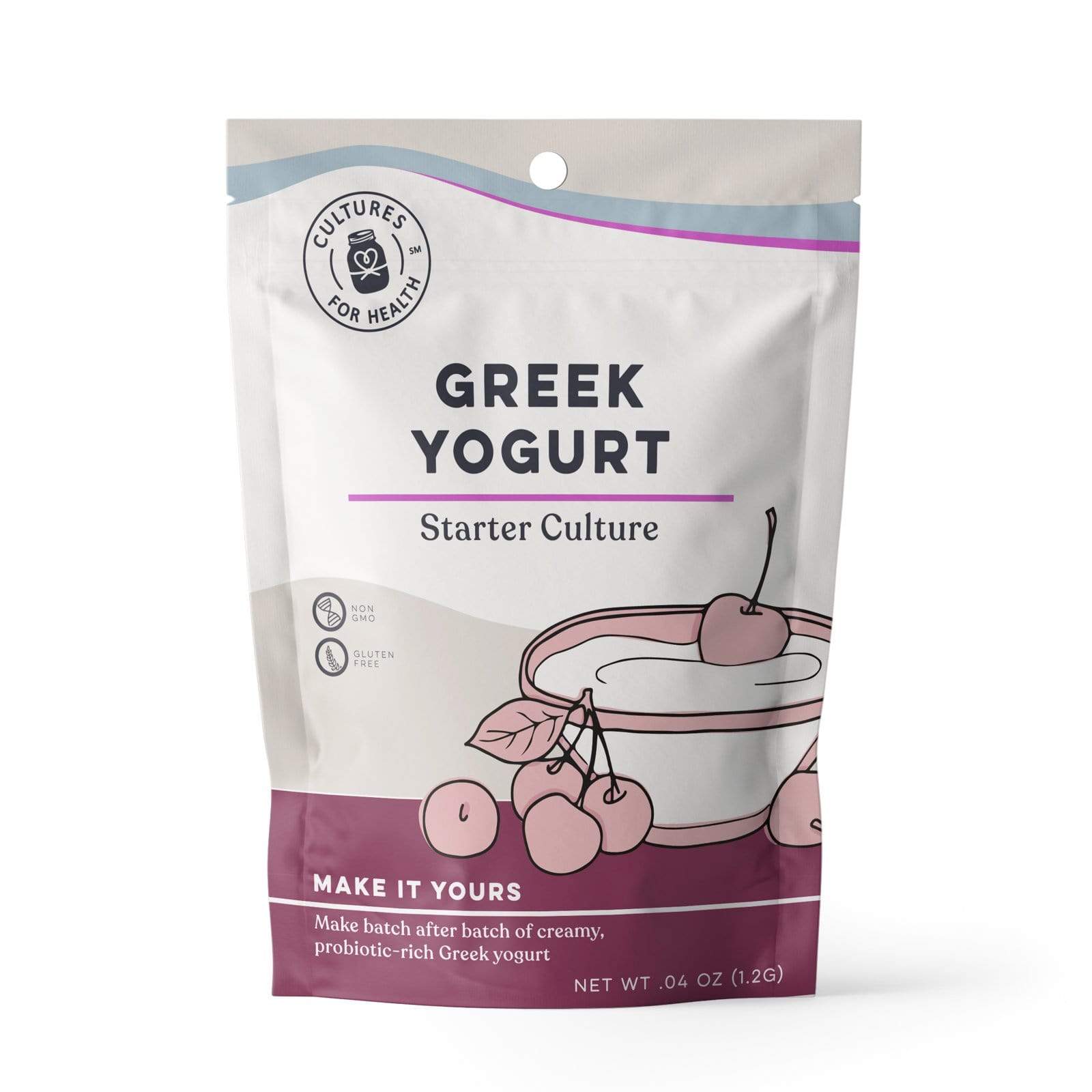
Greek Yogurt Starter

Availability: In stock

$12.99


Product Alerts

Perishable  

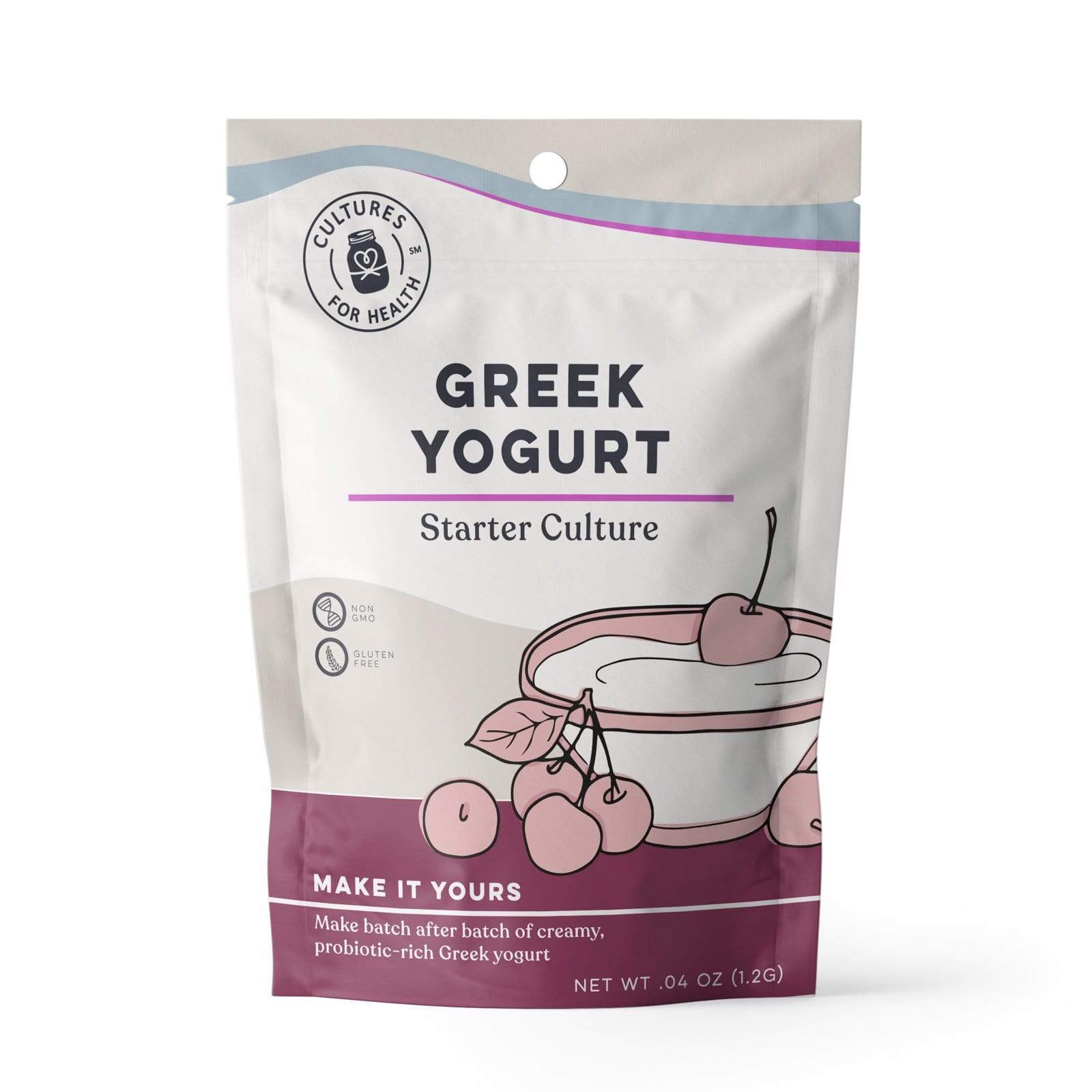
Greek Yogurt Starter

More Views

Share: FB

FREE eBOOK!

Get a free copy of our 
Learn to Make Yogurt eBook.
75+ page eBook including detailed instructions and recipes!

Ways to Use Greek Yogurt:

Details

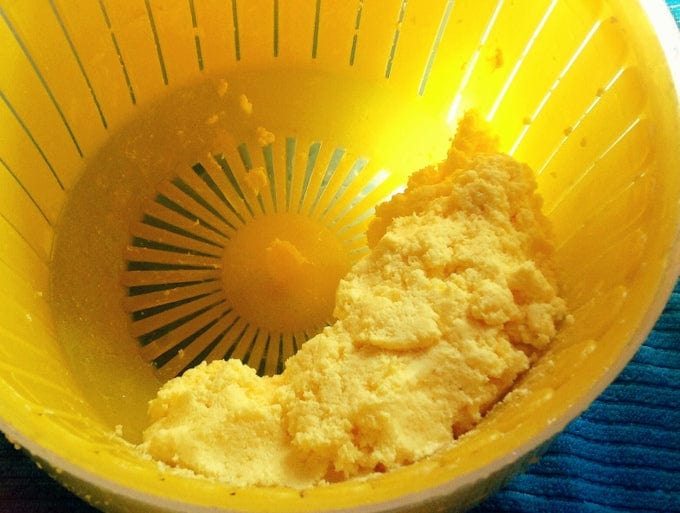
Our Traditional Greek yogurt starter makes a slightly tangy, rich and decadent homemade yogurt. It is particularly wonderful when made with a mixture of cream and milk (we recommend one part whipping cream and three parts whole milk). This yogurt can also be made with just whole milk or even low-fat milk for a less thick yogurt. Greek yogurt can also be partially strained to increase the thickness or can be strained further to produce a creamy Mascarpone cheese. If You are looking for something a little milder in flavor, try our Bulgarian yogurt starter.

Our Traditional Greek yogurt starter contains live active bacteria. One packet of Greek yogurt starter culture can be used to make unlimited amounts of homemade yogurt as it can be serial cultured: a small amount of yogurt from the current batch is reserved to inoculate the next batch of homemade yogurt. With care, our yogurt culture can be used to make Greek yogurt indefinitely. No more having to continually buy starter culture to make Greek yogurt! Save money by making your own Greek yogurt at home for a fraction of the cost of buying Greek-style yogurt in the store.


How to Make Greek Yogurt: Our Greek yogurt culture is a thermophilic yogurt culture and cultures with the aid of a yogurt maker or similar heat source. (Click here for alternatives to a yogurt-making appliance.) Our Greek yogurt culture can be serial cultured: a small amount of homemade yogurt from the current batch is reserved to inoculate the next batch of homemade yogurt. With care, our Greek yogurt culture can be used to make Greek yogurt indefinitely.

Our Greek starter culture can be used with goat milk although due to the lower fat content of goat milk, the resulting yogurt may be significantly less thick than yogurt made with whole cow milk.

Full instructions for making Greek Yogurt can be found here and will be shipped with your order.  Our instruction sheet also includes instructions for customers wishing to make yogurt with raw milk.

Using alternative milks: Greek Yogurt starter may be used with alternative milks (soy, coconut, etc.) but is unlikely to reculture beyond the first few generations. Therefore we strongly recommend keeping a backup dairy-based culture on hand for making yogurt with alternative milks. Greek yogurt starter can be used with goat milk although due to the nature of goat milk, the resulting yogurt may be significantly less thick than yogurt made with whole cow milk. We do not recommend using UHT (aka ultra-pasteurized) milk when working with any starter culture.

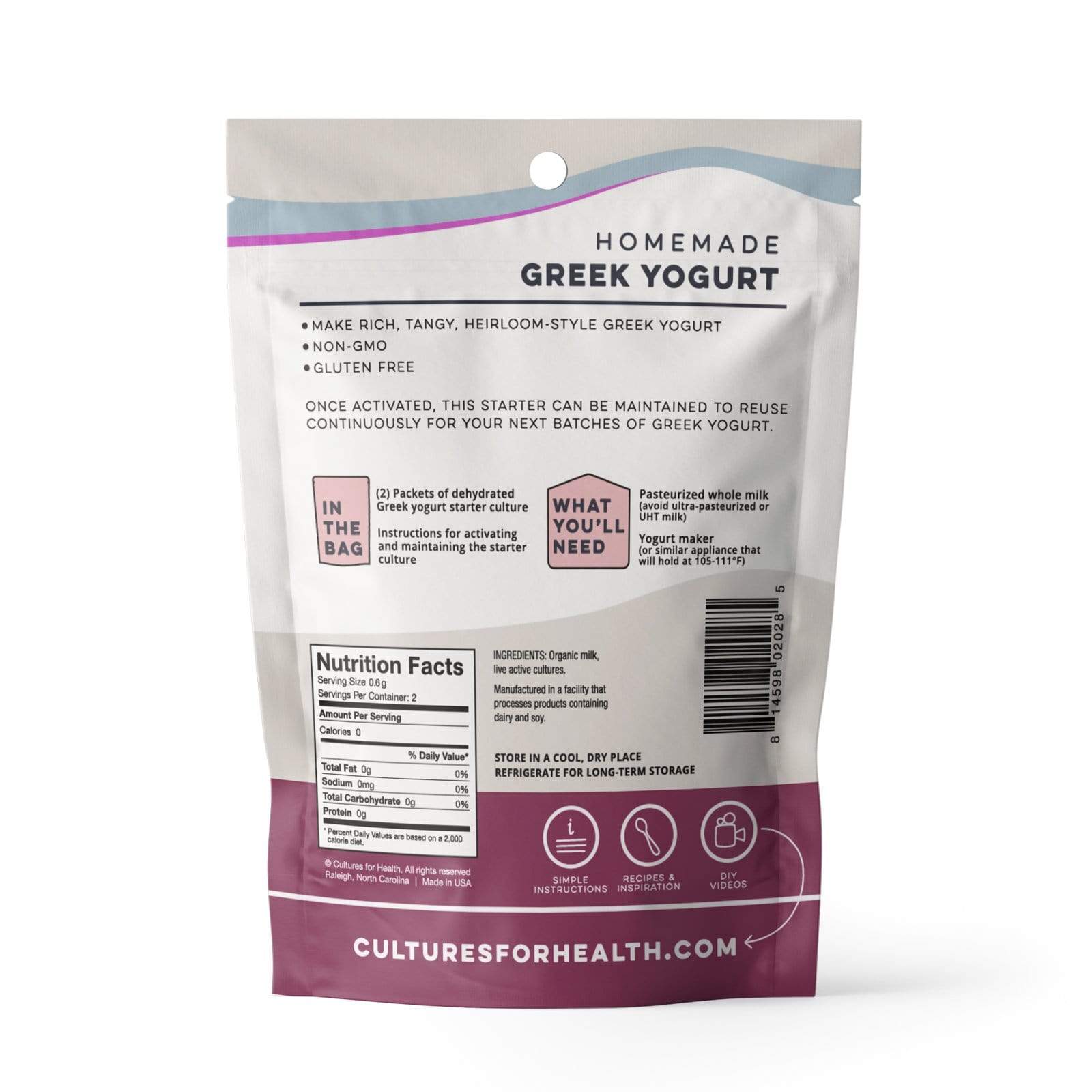
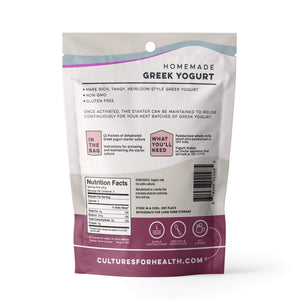
Ingredients: Organic milk, live active bacteria (L. Bulgaricus, S. Thermophilus).

Produced or packaged in a facility that also manufactures products made with wheat, dairy, soy, eggs, nuts, and fish.

Due to recent changes in manufacturing processes, the weight of the item that appears in the photo will differ from the actual weight of the item received.

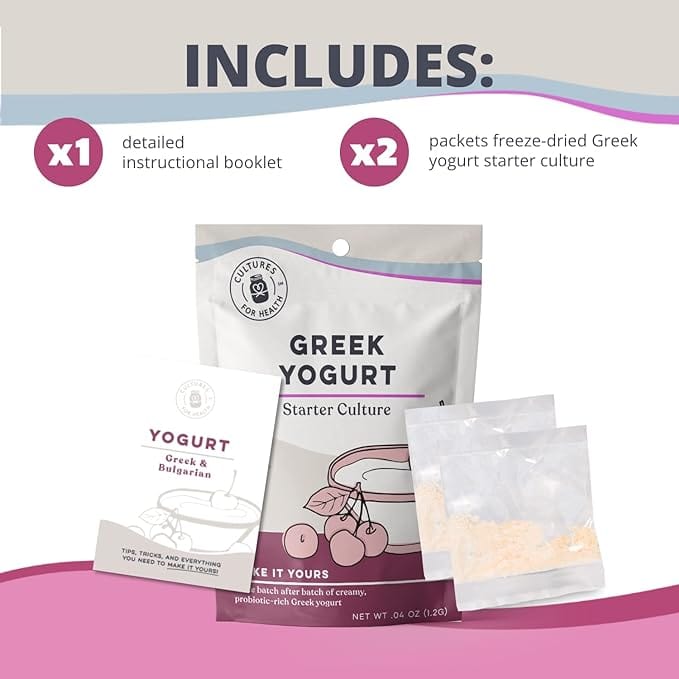
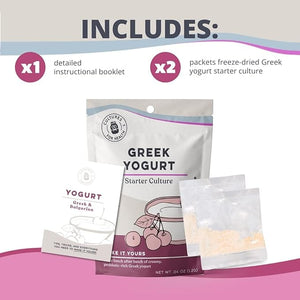
Shipping Information: Our starter culture is shipped in a barrier-sealed packet as a freeze-dried yogurt culture in a dairy carrier. Please keep it in a cool dry place until you are ready to make your first batch of homemade yogurt. We ship enough yogurt culture to make two batches of yogurt starter which you use as the starter culture to make unlimited amounts of yogurt. We recommend that you reserve half of the yogurt starter in a safe place to use as a back-up. 

 Detailed culturing instructions will be included with your order and can be found here.

Questions on Greek Yogurt Starter

Sort by Descending

Items 11 to 20 of 29 total

per page
Page:
  1. 1
  2. 2
  3. 3
  • From Jim Q at 12/7/11 11:27 PM
  • From The Cat Whispurrer at 12/9/11 11:51 AM
    • First, I'd like to say thanks SO much for including enough culture to make two batches of yogurt in each package!

      I purchased your Greek Starter and lost half of my first package of culture due to a faulty yogurt maker. I quickly replaced my yogurt maker with another and now have a cup of activated starter that looks like the thickest most wonderful Greek yogurt that I've ever seen!!!

      My question is this. Am I able to freeze a batch of the activated starter culture (meaning I'd like to freeze the heated and cooled cow's milk to which the initial culture has been added and already incubated)???

      Thanks very much!
    • You can try freezing a small amount of yogurt in ice cube trays to thaw later and use as starter yogurt. Freezing is not a perfect solution but it will usually work as long as the yogurt is only frozen for a short period of time (no more than a few weeks).
    • Do you find this question helpful?  Yes   No
  • From Michael at 12/19/11 12:22 PM
    • This is more of an answer to the question from Adrienne at 8/31/11 6:53 PM. There are four cups in a quart, not two, so the instructions in the video are correct.
    • Thank you Michael!
    • Do you find this question helpful?  Yes   No
  • From Harley at 2/4/12 2:44 PM
    • How many batches of a 2 quart maker does it make
    • Once you have activated your starter, you can make any size batch, using the ratio of one 1.5-2 teaspoons starter per cup of fresh milk.
    • Do you find this question helpful?  Yes   No
  • From Karen at 2/7/12 3:18 PM
    • 1) Is there a chart to help figure out the amount of protein, sugar and carbs in a 6oz jar of yogurt? I see commercial types like Chobani, say they have 2 times more protein than others. 18 grams for 6 oz. 2( Any suggestions how to boost the protein? 3) Also, any tips on how to decrease sugar? TU
    • The starter itself has no measurable nutrients; it's all bacteria. The nutrient content comes from the milk, and the carb (sugar) content will vary based on the milk, the fat content, the fermentation time, etc. Protein density can also be increased by straining the yogurt to remove the whey (liquid). The longer you ferment the yogurt, the less sugar it will have in it, as the bacteria eat up the lactose. (If you let it ferment too long, and the bacteria run out of food, they may weaken and/or die.)
    • Do you find this question helpful?  Yes   No
  • From Dawn at 2/9/12 9:56 AM
    • Can I use this with goat's milk?
    • Yes, any of our dairy yogurt starters can be used successfully with goat milk.
    • Do you find this question helpful?  Yes   No
  • From Tina at 3/9/12 3:39 PM
    • Raw Milk question - Ive read the instructions for the raw milk version, am I correctly reading that you cannot continue to reuse the starter from a batch of raw milk? I would have to continue to purchase starter if I continue to use raw milk?
    • You would not have to continue to purchase starter, you make and maintain a separate raw milk mother culture with milk that has been heated to 160°. You then use the mother culture to inoculate your raw milk (only heated to 110°) for your batches of yogurt. You will find information about using a thermophilic (heat activated) starter with raw milk in a chart on the following page: http://www.culturesforhealth.com/how-to-make-yogurt
    • Do you find this question helpful?  Yes   No
  • From WeeCareAcademyPreschool at 3/23/12 2:26 PM
    • Can I use this starter even if I do not use a yogurt Maker?
    • Yes, any of our thermophilic starters can be used without a yogurt maker. All you need is a way to keep them at the right temperature for the amount of time it takes to culture them. Here's an article with some tips: http://www.culturesforhealth.com/maintaining-temperatures-culturing-yogurt
    • Do you find this question helpful?  Yes   No
  • From Jennifer at 3/30/12 3:17 PM
    • Why do the instructions say to allow the yogurt to cool for two hours before placing it in the refrigerator?
      Because we are on the GAPS diet, I am already incubating the yogurt for 24 hours. Do you know if it is necessary to have that additional 2-hour cooling-down period? Or should I incubate the yogurt for 22 hours and then let it cool for 2 hours? Thank you.
    • Not necessary, a lot of people prefer to let things cool before putting them in the fridge. Try it both ways to see which you prefer.
    • Do you find this question helpful?  Yes   No
  • From Kathy at 5/1/12 2:10 PM
    • I have a question about making greek yogurt using raw cow's milk. The greek yogurt starter instructions state to use 1-2 cups raw milk, heat it to 160, let it cool down and then add one packet of the culture. Then, put it in the yogurt maker for about 5-8 hours. This creates a "mother" culture. I would then use a part of this mother culture to make my yogurt. This mother culture has to be remade every 7 days, according to the directions. The directions also state to only use a part of this mother culture to make yogurt as using part of the yogurt I've made as a starter will weaken the bacteria.

      Here's the question. Your website states that this $12.99 product will product virtually unlimited amounts of Greek yogurt but I don't see how since: 1. a new mother culture has to be made every 7 days and 2. I can only use the original mother culture as the culture starter in each yogurt batch, and 3. There's only 2 packets in this box. Could someone please explain this to me? I must be missing something.

      Thanks.
    • You will be using the previous mother culture to make your next mother culture. Once you make your first mother culture, you no longer need the powder starter. You simply use the previous mother starter to make a new mother starter.
    • Do you find this question helpful?  Yes   No

Ask Your Own Question


Back to the product page

Write Your Own Review

You're reviewing: Greek Yogurt Starter

How do you rate this product? *

  1 2 3 4 5
Value
Quality
Price

Customer Reviews

Excellent Yogurt Set Review by Katie
Quality
Price
Value
I have had great success with this yogurt. I use a eurocusine yogurt maker, the one with the seven little glass cups, so straining is not a convenient option for me. However, I have still made a very firm yogurt with this culture, even without straining. I add a half a cup of nonfat dried milk during the heating process and that makes all the difference. Using 2% milk, I get a set very similar to conventional Greek yogurt from the store. Using 1% resulted in a significantly looser set, but still tasty. All in all, great starter culture! I'm on my forth generation, saving a little bit from each batch to start the next one, and it's still going strong! (Posted on March 16, 2013)
WOW Review by Mij
Price
Value
Quality
I used a heating pan. Then I strained it. It was incredible!!!!! (Posted on March 4, 2013)
A great value for tasty, mild homemade yogurt. Review by amanda
Value
Quality
Price
I bought this culture a few months back and really like the quality. I read the instructions and followed them for refreshing the culture. At first, it looked like the culture would fail, but after having it fully refreshed (the longest incubating time was 7 hours for 1 quart of milk for the refreshing period), I have incubated many times with great results. I normally use regular whole milk or 2% and heat it to 180 degrees and hold it there for 5 minutes and chill it in an ice bath to get it down to incubating temperature faster. I use an older yogourmet incubater and incubate for roughly 4.5 hours each time and the result is a firmer (NOT like store bought firm, but firm enough that on a spoon it holds shape and the impression in the yogurt remains). I save some in a mason jar for starter culture for the next batch and strain the rest further for wonderfully thick Greek yogurt. I use it for recipes like homemade frozen yogurt, smoothies, and dessert toppings. Very mild taste that my children prefer over store bought. To make a great mild tasting vanilla flavor, I use 1/4 c. agave, 1 tablespoon of vanilla extract and mix with whisk in 4 cups of yogurt. For a sweeter version of vanilla and for freezing I increase the agave to almost 1/2 cup, but that is more like store bought frozen yogurt sweetness. I prefer this culture over the sachets from the health food store for yogurt culturing. This by far is a better deal. It lasts months and I still have the back up culture in my fridge. (So about 5 months of using it and it still works wonderfully). (Posted on March 2, 2013)
Excellent yogurt starter that fits my method of yogurt making Review by Toni
Quality
Price
Value
I always strain my yogurt, extracting a volume of whey equal to the volume of strained yogurt. From half gallon of pasteurized, organic, whole milk I get a quart of thick yogurt. So I cannot comment on the thickness of unstrained yogurt made with this starter. I know that for my method, using a Yogurmet yogurt maker and cheesecloth for straining, it is perfect. I save out starter from my new batch and use it for the next batch (about 1/3 cup to culture the half gallon of milk). The flavor and effectiveness are still there after the 5 batches that I have made so far. This is a big money saver in the long run. I only wish that, with so many different yogurt starters available from Cultures for Health you would make it more obvious from the package which cultures can be reused, like this one, and which are one-time cultures. (Posted on January 11, 2013)
Good Review by Cindy
Price
Value
Quality
This is the first yogurt I've ever made. I use raw cow's milk. The yogurt is not as thick as store bought,more like the thickness of a regular store bought yogurt, not Greek yogurt.

The flavor is good & I would recommend the starter. (Posted on December 15, 2012)
Nice! Review by Cindy
Value
Quality
Price
This is my first time making yogurt & everything went well. I used organic whole milk from the grocery store. The yogurt came out thick and creamy. It was just like you'd buy at the store! I am very pleased. (Posted on October 31, 2012)
Yummy Review by short muffin
Value
Quality
Price
So very yummy. I make about a gallon of milk with one cup cream at a time. I strain half of it. Both are great. My 6 year old didn't like it at first and now she eats it with honey instead of dessert. (Posted on May 11, 2011)
Love it! Review by Kathy
Price
Value
Quality
I bought and started using the Greek starter in January. The first little batch was thin and needed straining, but the other batches I have made have been wonderful. Sometimes I strain them for a thicker "greek-style" yogurt, sometimes not - great either way. Perfect with berries. (Posted on March 31, 2011)