














There are only three ingredients necessary in a vegetable ferments: vegetable, salt, and water. Because the ingredient list is so short, it is important that each ingredient be of the highest quality.
Obviously, choosing the best quality fresh produce is a priority, as well as the cleanest water. But what about salt?
To make the perfect fermenting choice, download our Cookbook Guide today.
TYPES OF SALT FOR FERMENTATION
Sea Salt
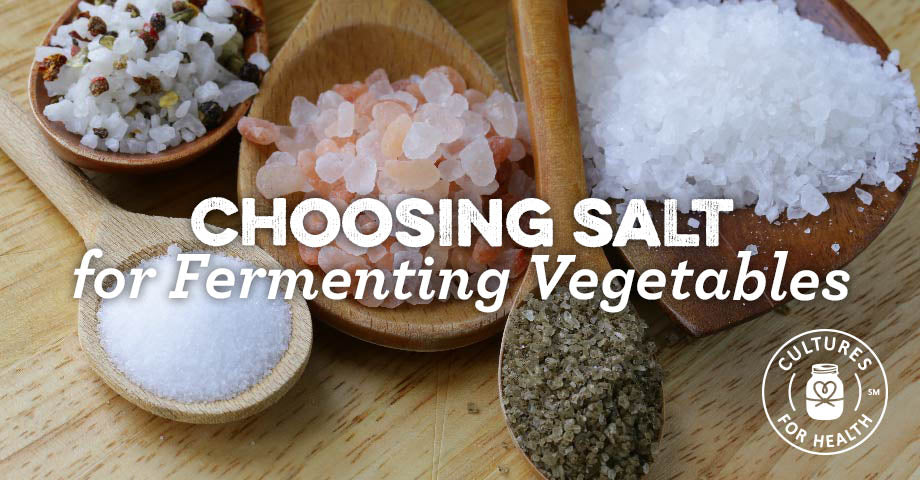
Sea salts are derived from sea water. They can be refined or unrefined, but are generally safer than iodized salts. When looking for an unrefined sea salt look for specks of color: gray, black, pink, or red. These colors indicate that the minerals have not been removed from the salt. Some natural salts are moist because they have not been fully dried or further refined after being extracted from the sea water.
Celtic sea salt is a CFH favorite for fermenting vegetables.
Himalayan Salt
Himalayan salt is a rock salt, more widely available as it gains in popularity. Himalayan salts are mineral-rich and can be pink or red in color, along with some white crystals. Himalayan salt also works well for fermenting vegetables.
Pickling Salt
Pickling salt is similar to iodized table salt, but without the iodine and anti-caking agents, so it can be used for fermenting vegetables. It is highly refined, though, so it may not be the optimal choice if you are looking for an unrefined, natural salt.
Kosher Salt
Kosher salt is also readily available in most grocery stores. Kosher salt is not “kosher” itself, but is used to make meats kosher and is also called “koshering” salt. It has a larger crystal than the granular table salt and does not contain as many additives as table salt. It does, however, sometimes contain anti-caking agents, so check the label before using kosher salt for fermenting vegetables.
Iodized Salt
Also known as table salt, iodized salt can be found in any grocery store. Iodine tends to inhibit the beneficial bacteria in a cultured vegetable, so we do not recommend using iodized salt for vegetable fermentation. Any container of salt should be clearly labeled if it is iodized (contains iodine). Check for and avoid anti-caking agents, as well.
An ideal salt for fermenting is whole, unrefined, and full of natural vitamins and minerals. Choose the best ingredients and your vegetable ferments will be healthy and delicious!