











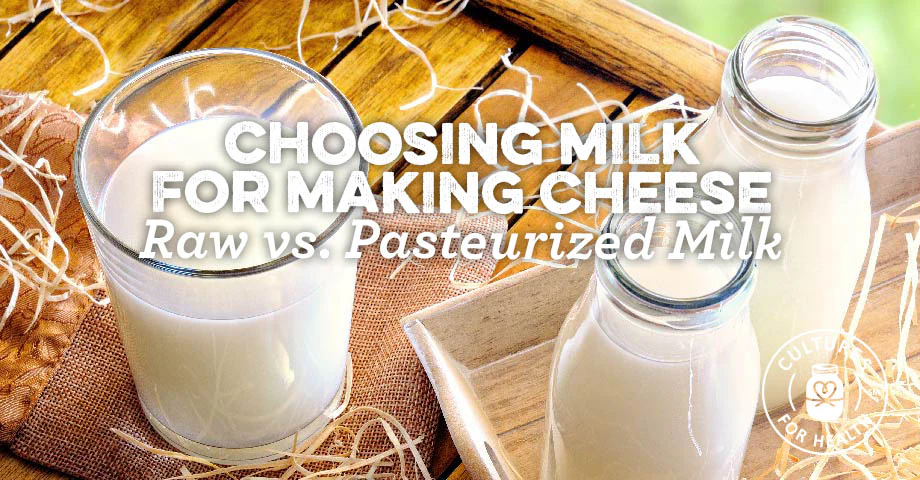
Many customers wonder if they can make cheese using raw milk. The answer is yes, of course! If raw milk is not available, however, do not let that stop you from making cheese! When it comes to cheesemaking, there are benefits and drawbacks to both raw and pasteurized milks.
Click to download our Cheesemaking Guide, which comes with tips and tricks to help you choose the suitable milk for your next batch of cheese.
BENEFITS TO USING RAW MILK
Milk is fresher. Raw milk is usually sold within 48 hours of milking the animal. Fresher milk means a stronger curd and higher yields, since the culture and rennet will have very little bacterial competition.
Cheese has more flavor. Raw milk is nuanced. Like wine or raw honey, the flavor of milk varies throughout the season. Depending on the type of cheese you make, there may be a hint of grass, clover, or alfalfa. Raw milk cheese will be sharper and have more of a cheesy bite, as well.
The farmer and animals are familiar. In several states, raw milk sales are legal at the farm gate only. This may seem like a drawback, but it is actually a benefit! You can get to know the farmer and animals. If you want to get really meticulous, you can vary the type of cheese you make based on the animals’ diet.
DRAWBACKS TO USING RAW MILK
Raw milk is not always available. It can be much more difficult to find than pasteurized. In some states, it is illegal, and in others it may require a long drive to find. There are very strict state and federal regulations governing the sale of milk, and they may change without notice.
Raw milk is expensive, often at least twice as expensive as pasteurized.
Raw milk comes with its own set of beneficial bacteria, and if your milk is a few days old or wasn't chilled down properly, that bacterial count can be high, giving the cheese culture some hefty competition, which can lead to cheese with an “off” flavor, or cheese that has a different flavor than you expect.
Raw milk carries risk. Although most people who consume raw milk do not feel that raw milk is inherently dangerous, there are risks to everything and people have become sick from raw milk on occasion. Aged cheeses are less problematic, because it is difficult for pathogenic bacteria to live in something aged over 60 days. But for fresh cheeses, raw milk can carry some risks. Talk to the farmer, research, and decide whether these risks are worth it.
BENEFITS TO USING PASTEURIZED MILK
Pasteurized milk is more widely available, and can be found at many grocery stores. However, ultra-pasteurized milk is becoming much more common, and pasteurized milk can be difficult to find in some areas. Ultra-pasteurized or UHT milk is not suitable for culturing.
Pasteurized milk is less expensive. It usually costs much less than raw milk.
Pasteurized milk contains fewer bacteria, beneficial or pathogenic, so the cheese culture has very little competition and can propagate freely, leading to a more consistently flavored cheese.
DRAWBACKS TO USING PASTEURIZED MILK
Cheese is not as flavorful. A raw cheese is a truly living food, full of enzymes and good bacteria. A pasteurized cheese contains enough good bacteria to turn it into cheese, but it will never have the same amount of flavor and nuance that a raw cheese does.
Processing may be inconsistent. Your milk may have been pasteurized at a high temperature. If it was heated past 165°F, the proteins are denatured (cooked) and won't make good cheese. The curds will be very soft and may not hold together.
Pasteurized milk carries risk. The largest outbreak of dairy-related foodborne illness was in the mid-1980s. Almost 20,000 people became sick with salmonella from improperly pasteurized milk. If something goes wrong with the pasteurization process, or the milk you use has gone bad, there is a potential for illness.
What Will You Use?
Choosing a milk for your cheesemaking endeavors can be tough. Research, talk to farmers and other local cheesemakers, and make the decision that is best for your family.
Click the link below to download our Cheesemaking Guide and Recipe book today!